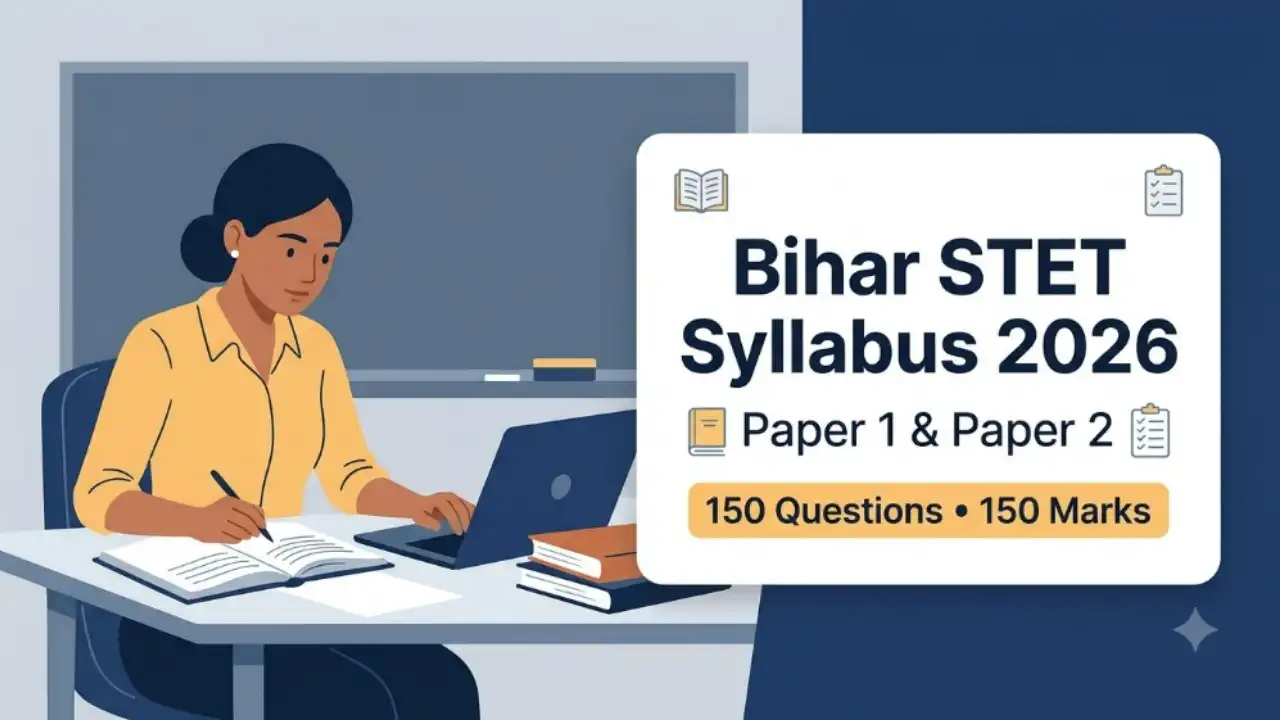
The Bihar School Examination Board (BSEB) has announced the Bihar Secondary Teacher Eligibility Test (STET) 2026, making the latest syllabus and exam pattern particularly important for candidates preparing for the examination. Bihar STET Paper 1 is conducted for secondary-level teaching eligibility, while Paper 2 is meant for higher secondary-level teaching eligibility.
Under the notified examination structure, each paper will carry 150 marks. Of these, 100 marks will be based on the specified subject selected by the candidate, while the remaining 50 marks will assess Teaching Art and Other Competencies. The test will be conducted in Computer-Based Test (CBT) mode for 150 minutes, with no negative marking.
Candidates applying for Bihar STET 2026 should therefore prepare their selected subject as the primary component while giving adequate attention to teaching aptitude, general awareness, environmental studies, mathematical ability and reasoning.
Table of Contents
Bihar STET Syllabus 2026 Overview
| Particular | Details |
|---|---|
| Exam Name | Bihar Secondary Teacher Eligibility Test (STET) 2026 |
| Conducting Authority | Bihar School Examination Board (BSEB) |
| Paper 1 | Secondary Level |
| Paper 2 | Higher Secondary Level |
| Examination Mode | Computer-Based Test |
| Question Type | Multiple Choice Questions |
| Questions in Each Paper | 150 |
| Maximum Marks | 150 |
| Specified Subject | 100 Marks |
| Teaching Art & Other Competencies | 50 Marks |
| Marks per Correct Answer | 1 Mark |
| Negative Marking | No |
| Duration | 150 Minutes |
Bihar STET Exam Pattern 2026
The Bihar STET 2026 notification confirms that the eligibility examination will consist of objective, multiple-choice questions. Each correct answer will carry one mark and there will be no conventional negative marking for an incorrect answer.
The broad examination structure is the same for Paper 1 and Paper 2.
| Section | Questions | Marks |
|---|---|---|
| Specified Subject | 100 | 100 |
| Teaching Art & Other Competencies | 50 | 50 |
| Total | 150 | 150 |
The 50-mark Teaching Art and Other Competencies portion has traditionally been organised into Teaching Art, General Knowledge, Environmental Science, Mathematical Aptitude and Logical Reasoning. The commonly followed distribution is given below.
| Area | Questions | Marks |
|---|---|---|
| Art of Teaching | 30 | 30 |
| General Knowledge | 5 | 5 |
| Environmental Science | 5 | 5 |
| Mathematical Aptitude | 5 | 5 |
| Logical Reasoning | 5 | 5 |
| Total | 50 | 50 |
Candidates should note that the latest notification expressly confirms the combined 50 marks for Teaching Art and Other Competencies. The above internal 30+5+5+5+5 distribution is consistent with the syllabus structure used for Bihar STET and reported for the 2026 examination.
Bihar STET Paper 1 Syllabus 2026
Bihar STET Paper 1 is the secondary-level eligibility paper and corresponds to subjects taught at the secondary school level. Candidates have to appear in the subject selected in their application according to their prescribed educational qualification.
The 2026 notification lists the following major Paper 1 subjects:
| Subject | Subject Code |
|---|---|
| Hindi | 101 |
| Urdu | 102 |
| Bengali | 103 |
| Maithili | 104 |
| Sanskrit | 105 |
| Arabic | 106 |
| Persian | 107 |
| Bhojpuri | 108 |
| English | 109 |
| Mathematics | 110 |
| Science | 111 |
| Social Science | 112 |
| Physical Education | 113 |
| Music | 114 |
| Fine Arts | 115 |
| Dance | 116 |
Provisions have also been made for Special School Teachers subject to the educational and professional qualifications prescribed in the notification.
Paper 1 Subject-Specific Syllabus
The 100-mark subject section is based on the prescribed curriculum for the relevant secondary-level subject. Candidates should prepare the concepts, terminology, applications and subject knowledge associated with the subject for which they are appearing.
For example, Mathematics candidates should concentrate on the prescribed mathematics curriculum and related concepts, while Science candidates need preparation across the applicable science disciplines. Social Science candidates should cover the prescribed areas connected with History, Geography, Political Science and Economics.
Language candidates should focus on their respective language, including areas such as grammar, literature, comprehension and relevant linguistic concepts according to the prescribed curriculum.
Bihar STET Paper 2 Syllabus 2026
Paper 2 is intended for candidates seeking higher secondary-level teaching eligibility. The subject-specific section again carries 100 marks, but candidates should prepare according to the curriculum and academic level applicable to the higher secondary subject selected by them.
Major Paper 2 subjects notified for STET 2026 include:
| Subject | Code |
|---|---|
| Hindi | 201 |
| Urdu | 202 |
| English | 203 |
| Sanskrit | 204 |
| Bengali | 205 |
| Maithili | 206 |
| Magahi | 207 |
| Arabic | 208 |
| Persian | 209 |
| Bhojpuri | 210 |
| Pali | 211 |
| Prakrit | 212 |
| Mathematics | 213 |
| Physics | 214 |
| Chemistry | 215 |
| Zoology | 216 |
| History | 217 |
| Geography | 218 |
| Political Science | 219 |
| Sociology | 220 |
| Economics | 221 |
| Philosophy | 222 |
| Psychology | 223 |
| Home Science | 224 |
| Commerce | 225 |
| Computer Science | 226 |
| Botany | 229 |
Other specialised subjects, including Agriculture and Music where applicable under the notification, should be prepared according to the prescribed subject curriculum and qualification requirements.
Teaching Art Syllabus for Bihar STET 2026
Teaching Art is one of the most important common portions of Bihar STET because candidates from different subjects have to demonstrate an understanding of teaching and classroom practices.
Important preparation areas include:
- Meaning and nature of teaching
- Characteristics and objectives of teaching
- Teaching-learning process
- Factors affecting teaching and learning
- Teaching methods and approaches
- Lesson planning
- Instructional planning
- Bloom’s Taxonomy and educational objectives
- Micro-teaching
- Classroom communication
- Classroom management
- Teaching aids and instructional resources
- Role and qualities of a teacher
- Learner-centred teaching
- Assessment and evaluation
- Different forms of evaluation
- Remedial teaching
- Use of textbooks and library resources
- Creating an effective classroom environment
Since this component can account for a substantial portion of the common section, candidates should not leave pedagogy preparation until the final stage.
General Knowledge Syllabus
The General Knowledge component is comparatively small, but it can provide quick marks when candidates have prepared consistently.
Preparation should broadly cover:
- Indian History
- Geography of India
- Bihar-related general awareness
- Indian Polity
- Important national institutions
- Science and everyday applications
- Important national and international events
- Sports
- Awards and honours
- Important personalities
- Current affairs
Candidates should combine static general knowledge with recent current affairs instead of concentrating exclusively on either one.
Environmental Science Syllabus
The Environmental Science section assesses awareness of fundamental environmental concepts and contemporary ecological problems.
Important topics may include:
- Ecosystem and ecology
- Natural resources
- Biodiversity
- Flora and fauna
- Environmental pollution
- Air, water and soil pollution
- Solid waste management
- Deforestation
- Global warming
- Climate-related environmental issues
- Conservation of natural resources
- Sustainable development
- Basic environmental protection concepts
This section generally requires conceptual clarity rather than highly specialised environmental-science knowledge.
Mathematical Aptitude Syllabus
Mathematical Aptitude tests fundamental numerical ability. Candidates from non-Mathematics subjects should devote regular practice to this portion.
Important areas include:
- Number system
- Simplification
- Fractions and decimals
- Ratio and proportion
- Percentage
- Average
- Profit and loss
- Simple interest
- Basic arithmetic
- Partnership
- Time and work
- Time, speed and distance
- Basic algebra
- Mensuration
- Elementary data interpretation
Accuracy and calculation speed are particularly important because candidates must manage this section alongside a 100-question subject paper.
Logical Reasoning Syllabus
The Logical Reasoning section evaluates analytical and problem-solving ability rather than specialised academic knowledge.
Candidates can prepare topics such as:
- Analogy
- Classification
- Series
- Coding and decoding
- Blood relations
- Direction sense
- Ranking and order
- Logical sequence
- Statement-based reasoning
- Basic analytical reasoning
- Number and letter patterns
- Simple problem-solving questions
Regular practice is generally more useful for this section than extensive theoretical study.
Bihar STET Paper 1 vs Paper 2
| Feature | Paper 1 | Paper 2 |
|---|---|---|
| Teaching Level | Secondary | Higher Secondary |
| Target Classes | Classes 9-10 | Classes 11-12 |
| Subject Questions | 100 | 100 |
| Teaching Art & Other Competencies | 50 | 50 |
| Total Questions | 150 | 150 |
| Total Marks | 150 | 150 |
| Duration | 150 Minutes | 150 Minutes |
| Negative Marking | No | No |
The main difference is therefore the level and nature of the specified subject, rather than the overall examination structure.
Is There Negative Marking in Bihar STET 2026?
There is no conventional negative marking for incorrect answers in Bihar STET 2026. Candidates receive one mark for every correct answer.
However, the notification also explains that the examination may be conducted in multiple shifts and normalisation may be used for preparation of results. Therefore, candidates should not interpret the absence of negative marking as a reason to make completely random attempts.
Bihar STET 2026 Exam Duration
Candidates will receive 150 minutes, or 2 hours 30 minutes, to complete 150 questions.
This gives an average of approximately one minute per question. Since the specified subject itself carries 100 questions, a sensible examination strategy is to complete familiar subject questions first and reserve sufficient time for Teaching Art and the other competency areas.
How to Prepare Bihar STET Syllabus 2026
Candidates should divide preparation according to the actual weightage of the examination rather than studying every section equally.
1. Give Maximum Time to the Specified Subject
The selected subject contributes 100 out of 150 marks, or roughly two-thirds of the paper. Strong command over the subject should therefore remain the first priority.
Prepare the prescribed curriculum systematically and revise factual, conceptual and application-based areas separately.
2. Do Not Ignore Teaching Art
Teaching Art forms a significant part of the remaining marks. Candidates with excellent subject knowledge can still lose useful marks if pedagogy is left unprepared.
Prepare educational objectives, teaching methods, lesson planning, classroom practices, assessment and evaluation carefully.
3. Practise Aptitude and Reasoning Regularly
Mathematics and reasoning can be improved through short daily practice sessions. Candidates should concentrate on accuracy before attempting to increase speed.
4. Revise GK and Environment in Short Cycles
Instead of keeping General Knowledge and Environmental Science for the final week, revise a limited number of topics every day. Current affairs should also be updated regularly.
5. Use Previous-Year Papers and Mock Tests
Previous Bihar STET questions can help candidates understand the nature of subject questions and the practical difficulty level of the common section.
Once the syllabus has been substantially covered, full-length mocks of 150 questions in 150 minutes should become part of the preparation schedule.
Recommended Preparation Priority
A practical preparation order can be:
- Specified Subject
- Art of Teaching
- Mathematical Aptitude and Logical Reasoning
- General Knowledge
- Environmental Science
- Full-length mock tests and revision
The exact amount of study time should depend on the candidate’s strengths. A candidate already strong in the specified subject can allocate more time to Teaching Art and aptitude, while candidates returning to their academic subject after a long gap may need to spend more time rebuilding core concepts.
Bihar STET Syllabus 2026: Key Points to Remember
- Bihar STET 2026 has Paper 1 and Paper 2.
- Paper 1 is for secondary-level teaching eligibility.
- Paper 2 is for higher secondary-level teaching eligibility.
- Each paper contains 150 objective questions.
- Maximum marks are 150.
- The specified subject carries 100 marks.
- Teaching Art and Other Competencies carry 50 marks.
- Each correct answer carries 1 mark.
- There is no conventional negative marking.
- Examination duration is 150 minutes.
- The examination will be held in CBT mode.
- Candidates should prepare the syllabus according to the subject selected in their application.
Frequently Asked Questions
What is the Bihar STET syllabus for 2026?
Bihar STET 2026 consists of a 100-mark specified-subject section and a 50-mark section covering Teaching Art and Other Competencies.
How many questions are asked in Bihar STET?
Each Bihar STET paper contains 150 multiple-choice questions carrying a total of 150 marks.
Is there negative marking in Bihar STET 2026?
No conventional negative marking has been prescribed for wrong answers. Each correct answer carries one mark.
What is the duration of Bihar STET 2026?
Candidates are given 150 minutes, equivalent to 2 hours and 30 minutes.
What is the difference between Bihar STET Paper 1 and Paper 2?
Paper 1 relates to secondary-level teaching, generally Classes 9 and 10, while Paper 2 relates to higher secondary-level teaching, generally Classes 11 and 12.
Which section carries the highest weightage?
The specified subject carries 100 of the total 150 marks, making it the most important part of the examination.