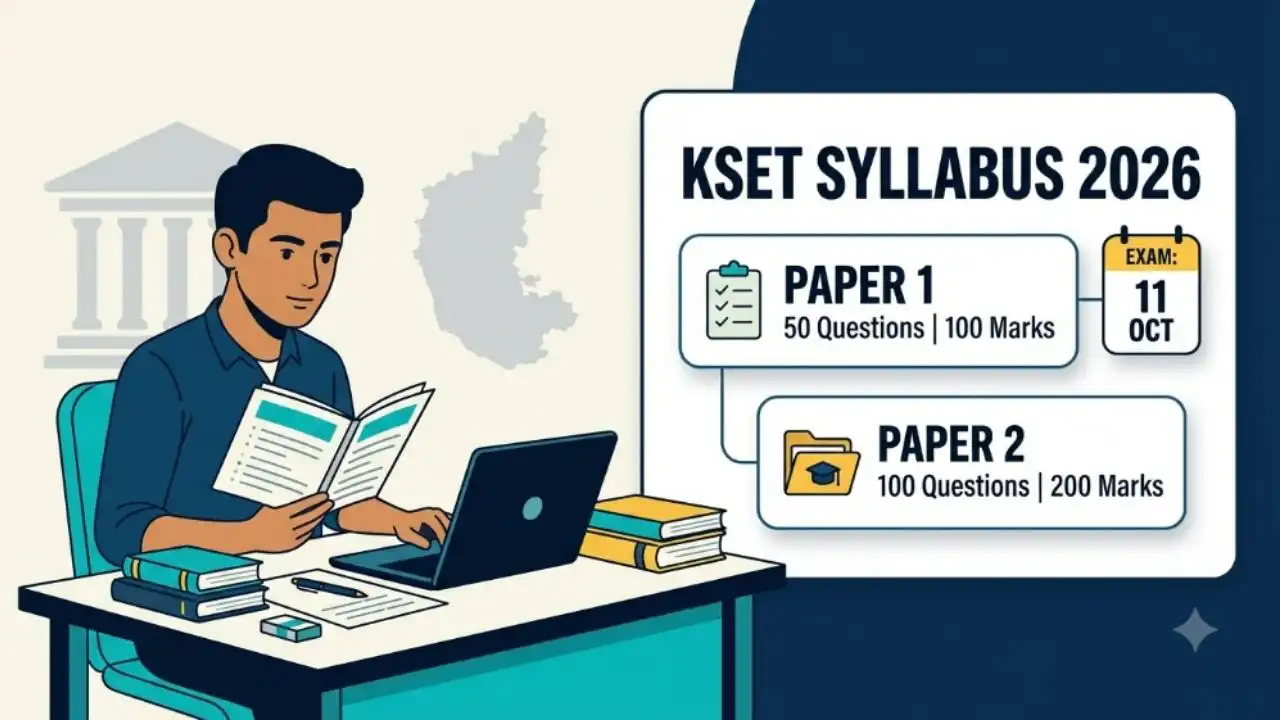
The KSET Syllabus 2026 is an important starting point for candidates preparing for the Karnataka State Eligibility Test scheduled for 11 October 2026. Karnataka Examinations Authority (KEA) will conduct KSET 2026 through two compulsory papers carrying a combined 300 marks. Paper 1 tests teaching and research aptitude, reasoning, comprehension, communication and general academic abilities, while Paper 2 assesses the candidate’s chosen postgraduate subject.
The KSET 2026 notification was released in August 2026. Candidates preparing for the examination should therefore move from general preparation to syllabus-based study. The examination will have 150 questions in total, comprising 50 questions in Paper 1 and 100 questions in Paper 2.

For Paper 2, candidates should prepare according to the prescribed UGC-NET/CSIR-UGC NET syllabus applicable to their subject. The complete KSET exam pattern, Paper 1 syllabus, Paper 2 subjects and preparation priorities are explained below.
Table of Contents
KSET Syllabus 2026 Overview
| Particular | Details |
|---|---|
| Examination | Karnataka State Eligibility Test (KSET) 2026 |
| Conducting Authority | Karnataka Examinations Authority (KEA) |
| Purpose | Eligibility for Assistant Professor |
| Exam Date | 11 October 2026 |
| Number of Papers | 2 |
| Paper 1 | Teaching and Research Aptitude |
| Paper 2 | Subject selected by the candidate |
| Total Questions | 150 |
| Total Marks | 300 |
| Exam Duration | 3 Hours |
| Exam Timing | 10:00 AM to 1:00 PM |
| Question Type | Objective Multiple-Choice Questions |
| Paper 2 Subjects | 37 |
| Negative Marking | No negative marking prescribed |
KSET Exam Pattern 2026
KSET 2026 consists of Paper 1 and Paper 2, and both papers are compulsory. The examination is conducted in a single three-hour session.
| Paper | Number of Questions | Marks | Marks per Question |
|---|---|---|---|
| Paper 1 | 50 | 100 | 2 |
| Paper 2 | 100 | 200 | 2 |
| Total | 150 | 300 | — |
Candidates are required to answer all 150 questions. Paper 1 is common to candidates from all subjects, whereas Paper 2 changes according to the subject selected in the KSET application.
The official notification does not prescribe negative marking. Candidates can therefore attempt questions without a deduction for an incorrect response.
KSET Paper 1 Syllabus 2026
KSET Paper 1 is designed to assess whether a candidate possesses the teaching, research, reasoning and general academic aptitude expected for higher education.
Candidates should prepare the following major areas.
Teaching Aptitude
This unit deals with the fundamentals of teaching and the teaching-learning process.
Important areas include:
- Teaching concepts, objectives and characteristics
- Basic requirements of teaching
- Learner characteristics
- Factors affecting teaching
- Teacher-centred and learner-centred methods
- Offline and online teaching methods
- Teaching support systems
- Evaluation systems
- Types and methods of assessment
Candidates should understand concepts rather than relying only on factual memorisation.
Research Aptitude
Research Aptitude examines a candidate’s understanding of research methodology and academic research practices.
Important topics include:
- Meaning and characteristics of research
- Types of research
- Methods of research
- Steps involved in research
- Research ethics
- Thesis and article writing
- Referencing and academic practices
- Application of ICT in research
Questions may test both conceptual knowledge and the practical application of research principles.
Comprehension
Candidates are given a passage followed by questions based on it.
Questions generally assess:
- Main idea of the passage
- Interpretation
- Inference
- Vocabulary in context
- Author’s argument
- Factual understanding
Regular practice with short academic and analytical passages can improve accuracy in this section.
Communication
This unit covers different forms and processes of communication.
Important areas include:
- Meaning and characteristics of communication
- Types of communication
- Verbal communication
- Non-verbal communication
- Classroom communication
- Inter-cultural communication
- Group communication
- Barriers to effective communication
- Mass media and society
Candidates should particularly understand the communication process, barriers and classroom communication.
Mathematical Reasoning and Aptitude
This section tests basic quantitative reasoning rather than advanced mathematics.
Important topics include:
- Number series
- Letter series
- Codes and relationships
- Fractions
- Percentage
- Ratio and proportion
- Average
- Profit and loss
- Time and distance
- Basic mathematical reasoning
Candidates should focus on calculation speed and concept-based practice.
Logical Reasoning
Logical Reasoning is one of the important scoring areas in KSET Paper 1.
Topics include:
- Understanding arguments
- Structure of arguments
- Deductive reasoning
- Inductive reasoning
- Analogies
- Venn diagrams
- Logical fallacies
- Classical square of opposition
- Indian logic
- Means of knowledge
Candidates should practise questions rather than study this unit only theoretically.
Data Interpretation
Candidates may be given numerical information represented through tables or graphical formats.
Preparation should cover:
- Sources of data
- Acquisition and classification of data
- Quantitative data
- Qualitative data
- Tables
- Bar graphs
- Histograms
- Pie charts
- Line graphs
- Interpretation and comparison of data
Percentage, ratio and average calculations are particularly useful for this section.
Information and Communication Technology
The ICT section assesses basic knowledge of computers, the internet and digital technologies used in education and communication.
Important topics include:
- ICT terminology
- Fundamentals of computers
- Internet
- Intranet
- Digital communication
- Audio conferencing
- Video conferencing
- Digital initiatives in higher education
Candidates should also remain familiar with the practical application of ICT in teaching and research.
People, Development and Environment
This unit combines environmental awareness with sustainable development issues.
Important topics include:
- Development and environment
- Sustainable development
- Sustainable Development Goals
- Human-environment interaction
- Environmental pollution
- Climate change
- Natural resources
- Renewable resources
- Natural hazards and disasters
- Environmental protection
Conceptual understanding of environmental issues is more useful than memorising isolated facts.
Higher Education System
This unit focuses on the evolution, administration and governance of higher education in India.
Important areas include:
- Institutions of higher learning in ancient India
- Development of higher education after Independence
- Conventional learning programmes
- Non-conventional learning programmes
- Professional education
- Technical education
- Value education
- Environmental education
- Policies in higher education
- Governance and administration
Candidates preparing for KSET should give adequate attention to this unit because many concepts are directly connected with the purpose of the eligibility examination.
KSET Paper 2 Syllabus 2026
Paper 2 is subject-specific and carries 200 of the total 300 marks, making it the most important component of the examination.
Candidates have to answer 100 compulsory questions, each carrying two marks.
The Paper 2 syllabus depends on the subject selected by the candidate. KEA has provided for KSET 2026 across 37 subjects.
KSET 2026 Subject List
The subjects covered under KSET 2026 include:
- Commerce
- Kannada
- Economics
- English
- Political Science
- History
- Sociology
- Geography
- Hindi
- Management
- Tourism Administration and Management
- Education
- Library and Information Science
- Mass Communication and Journalism
- Psychology
- Social Work
- Law
- Sanskrit
- Physical Education
- Folk Literature
- Urdu
- Public Administration
- Computer Science and Applications
- Physical Sciences
- Mathematical Sciences
- Chemical Sciences
- Forensic Science
- Life Sciences
- Environmental Sciences
- Home Science
- Electronic Science
- Earth Sciences
- Philosophy
- Women Studies
- Performing Arts
- Music
- Visual Arts
Candidates should prepare Paper 2 according to the syllabus applicable to their selected subject rather than studying a common Paper 2 curriculum.
Which Syllabus Applies to KSET Paper 2?
For the subject paper, candidates need to follow the relevant UGC-NET or CSIR-UGC NET syllabus, depending on the discipline.
This distinction is particularly important for science subjects. Candidates should first identify the prescribed syllabus for their KSET subject and then prepare unit by unit.
The syllabus should also be checked carefully by candidates whose postgraduate qualification falls under an allied or equivalent discipline, as the KSET notification contains subject-equivalence provisions for certain courses.
KSET Paper 1 vs Paper 2: Where Should Candidates Focus?
Paper 2 accounts for 200 marks, compared with 100 marks for Paper 1. Candidates should therefore not divide their study time equally between the two papers.
A practical preparation distribution could be:
| Preparation Area | Suggested Priority |
|---|---|
| Paper 2 subject preparation | Highest |
| Paper 1 reasoning and data interpretation | High |
| Teaching and research aptitude | High |
| Higher education and ICT | Moderate to High |
| Communication and comprehension | Moderate |
| Revision and mock tests | High |
Candidates who already have a strong postgraduate subject base can devote additional time to Paper 1 because comparatively small improvements across its ten units can significantly increase the overall score.
Important Topics for KSET Paper 1
While candidates should cover the complete syllabus, some areas deserve additional practice because they involve concepts and problem-solving rather than simple memorisation.
Priority areas include:
- Teaching methods and evaluation
- Research methodology and research ethics
- Logical reasoning
- Mathematical reasoning
- Data interpretation
- Communication barriers
- ICT fundamentals
- Sustainable development and environment
- Higher education governance
Reasoning and data interpretation should be practised regularly rather than left for final revision.
How to Prepare KSET Paper 2
Paper 2 carries two-thirds of the total examination marks, so candidates should build their preparation around it.
Start by dividing the subject syllabus into individual units. Complete the conceptual portion of each unit before attempting objective questions. Once approximately half of the syllabus has been completed, begin solving previous KSET and relevant NET-level questions.
Candidates should identify three categories while preparing:
- Strong units that require only revision
- Moderate units requiring additional practice
- Weak units requiring concept rebuilding
More study time should be allocated to the second and third categories.
Role of Previous-Year KSET Papers
Previous-year papers are useful for understanding the actual depth of questions expected in the examination.
Candidates can use them to identify:
- Frequently tested concepts
- Question difficulty
- Repeated topic areas
- Conceptual versus factual questions
- Time required for Paper 1
- Depth expected in Paper 2
Previous papers should, however, supplement the syllabus rather than replace it. A topic should not be ignored simply because it has appeared infrequently in earlier examinations.
Recommended KSET 2026 Preparation Order
With the examination scheduled for 11 October 2026, candidates should now follow a structured preparation cycle.
Stage 1: Complete Core Paper 2 Units
Begin with high-weight and concept-heavy units of the chosen subject. Prepare notes simultaneously so that revision is faster later.
Stage 2: Cover Paper 1 Alongside Paper 2
Allocate regular study sessions to Paper 1. Logical Reasoning, Research Aptitude, Teaching Aptitude and Data Interpretation are good starting areas.
Stage 3: Start Topic-Wise Questions
After completing each unit, attempt objective questions from the same topic. This helps identify whether concepts have actually been understood.
Stage 4: Solve Previous Papers
Once a substantial portion of the syllabus is complete, start attempting previous KSET and relevant NET papers.
Stage 5: Attempt Full-Length Mock Tests
The actual examination consists of 150 questions in three hours. Full mock tests are therefore essential for developing speed, concentration and question-selection discipline.
Stage 6: Final Revision
During the final weeks, candidates should focus on revision notes, difficult concepts, previous mistakes and mock-test analysis rather than continuously adding new study material.
KSET 2026 Minimum Qualifying Marks
The KSET notification prescribes minimum aggregate marks in both papers taken together.
| Category | Minimum Aggregate Marks |
|---|---|
| General Merit | 40% |
| Reserved Categories specified under KSET rules | 35% |
Merely securing the minimum aggregate does not automatically mean that a candidate will be declared KSET qualified. Final qualification is determined according to the prescribed subject-wise and category-wise procedure.
Is There Negative Marking in KSET 2026?
The KSET 2026 notification does not prescribe negative marking for incorrect responses.
Candidates can therefore attempt questions after reasonable elimination instead of leaving large numbers unanswered solely because of fear of a mark deduction.
What Candidates Should Do Now
With KSET 2026 scheduled for 11 October, candidates have a defined preparation window. The immediate priority should be to download or verify the syllabus corresponding to the selected Paper 2 subject and divide it into manageable units.
Paper 2 should receive the largest share of preparation time because it carries 200 marks, while Paper 1 should be prepared consistently through topic-wise practice. Candidates should complete major concepts early enough to reserve sufficient time for previous papers, mock tests and revision before the examination.
Frequently Asked Questions
What is the KSET 2026 exam date?
KSET 2026 is scheduled to be conducted on 11 October 2026.
How many papers are there in KSET 2026?
The examination consists of two compulsory papers, Paper 1 and Paper 2.
How many questions are asked in KSET?
KSET has 150 questions in total. Paper 1 contains 50 questions, and Paper 2 contains 100 questions.
What are the total marks in KSET 2026?
KSET 2026 carries a total of 300 marks. Paper 1 is worth 100 marks, and Paper 2 is worth 200 marks.
Is there negative marking in KSET 2026?
The official KSET notification does not prescribe negative marking for incorrect answers.
What is the syllabus for KSET Paper 1?
Paper 1 covers Teaching Aptitude, Research Aptitude, Comprehension, Communication, Mathematical Reasoning, Logical Reasoning, Data Interpretation, ICT, People and Environment, and Higher Education System.
What is the syllabus for KSET Paper 2?
Paper 2 is based on the subject selected by the candidate. Candidates should follow the applicable UGC-NET or CSIR-UGC NET syllabus for their subject.
How many subjects are available in KSET 2026?
KSET 2026 is being conducted across 37 subjects.