
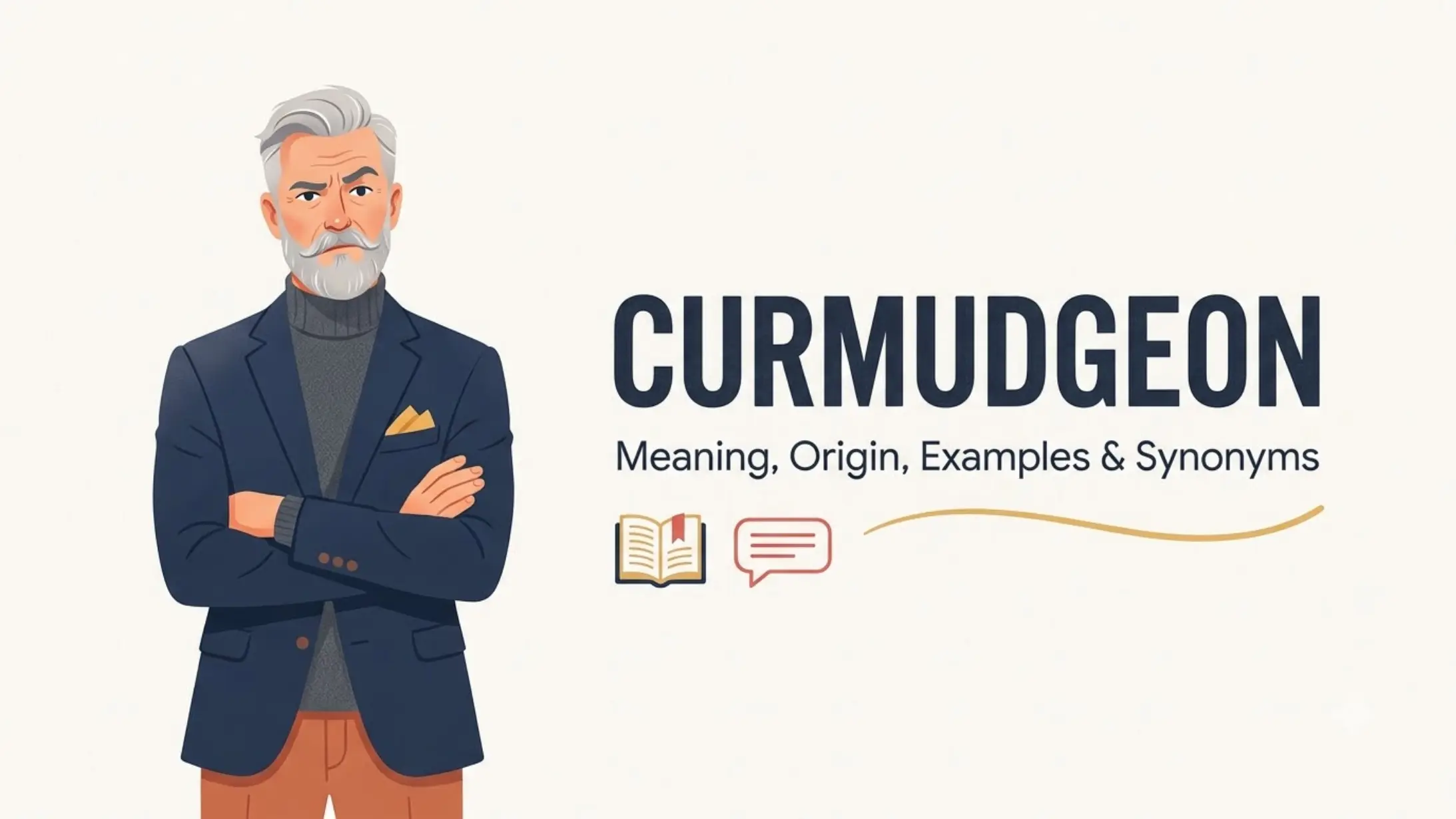
Some people seem permanently unimpressed. They complain about changing traditions, dislike new ideas, and rarely hesitate to express their irritation. English has a distinctive word for such a personality: curmudgeon.
Today’s word of the day can make descriptions more vivid, particularly when discussing a grumpy, stubborn, or habitually bad-tempered person. However, its tone and context require careful handling.
Table of Contents
Curmudgeon Meaning in English
A curmudgeon is a bad-tempered, difficult or habitually complaining person. The word is frequently associated with an older man who is stubborn, irritable and resistant to change, although it can describe a person of any age or gender.
Word: Curmudgeon
Part of speech: Noun
Pronunciation: ker-MUJ-un
Plural: Curmudgeons
Adjective form: Curmudgeonly
Simple meaning
A curmudgeon is someone who is usually grumpy, argumentative or easily annoyed.

For example, an elderly neighbour who constantly complains about children playing outside, changing technology and modern lifestyles might be described as a curmudgeon.
What Does Curmudgeon Really Imply?
The word carries more personality than ordinary terms such as “angry” or “unhappy.” A curmudgeon is not necessarily furious at a particular moment. Instead, the person is generally known for being irritable, pessimistic, stubborn or difficult to please.
The term can sound critical, but it is sometimes used with humor or reluctant affection. A fictional character may be described as a “lovable curmudgeon” when the person appears harsh and grumpy but secretly has a caring nature.
Therefore, context determines whether the word feels insulting, playful or affectionate.
Origin of the Word Curmudgeon
The precise origin of curmudgeon remains uncertain.
The word appeared in English during the late sixteenth century, with early recorded forms dating to around the 1560s and 1570s. It was originally used for a disagreeable, miserly or ill-tempered man.
Several theories have attempted to connect it with Scottish, Gaelic, or French expressions. However, linguists and major dictionaries generally treat its etymology as unresolved because no proposed explanation has gained sufficient historical support.
Although its linguistic roots remain mysterious, the word has survived for centuries because it captures a recognizable type of personality with unusual precision.
Examples of Curmudgeon in Sentences
Here are some natural examples showing how the word can be used:
- The neighborhood curmudgeon complained whenever children played near his garden.
- My grandfather pretends to be a curmudgeon, but he quietly helps everyone in the family.
- The novel follows a lonely curmudgeon whose life changes after he befriends a young neighbor.
- Do not become a curmudgeon simply because the office has introduced new software.
- Although the professor had a reputation as a curmudgeon, his students respected his honesty.
- The shopkeeper was considered a curmudgeon because he rarely smiled and argued with impatient customers.
- Beneath his curmudgeonly behaviour, he was a generous and compassionate person.
- She jokingly called herself a curmudgeon after refusing to attend another noisy party.
Synonyms for Curmudgeon
Several words have meanings similar to curmudgeon, although their emotional force and usage may differ.
Grouch: A person who frequently complains or remains in a bad mood.
Grump: An informal term for someone who is habitually irritable.
Crank: An eccentric, bad-tempered or unreasonable person.
Cynic: Someone who distrusts people’s motives or expects selfish behaviour.
Misanthrope: A person who strongly dislikes or distrusts humanity.
Killjoy: Someone who spoils other people’s enjoyment.
Complainer: A person who regularly expresses dissatisfaction.
Crotchety person: Someone who is easily annoyed and difficult to deal with.
Cantankerous person: Someone who is argumentative, bad-tempered and uncooperative.
“Grouch” and “grump” are the closest choices in casual conversation. “Misanthrope” is stronger because it suggests a broad dislike of people, while “killjoy” specifically refers to someone who ruins enjoyment.
Curmudgeon vs Grumpy
The words are related but grammatically different.
Grumpy is usually an adjective describing a temporary mood or general disposition.
He was grumpy because he had not slept well.
Curmudgeon is a noun describing a person recognized for persistent irritability, stubbornness, or complaining.
Everyone considered him the office curmudgeon.
A person can feel grumpy for one morning without being a curmudgeon. The latter suggests a more established personality or reputation.
How to Use Curmudgeon Correctly
Use “curmudgeon” when describing someone whose bad temper, stubborn opinions or constant complaints form a noticeable part of their personality.
Common expressions include:
- An old curmudgeon
- A lovable curmudgeon
- The office curmudgeon
- A grumpy curmudgeon
- A self-described curmudgeon
- A charming curmudgeon
The adjective curmudgeonly can describe behavior, comments, attitudes, or personality.
Examples:
He delivered a curmudgeonly speech about modern technology.
Her curmudgeonly remarks made the meeting uncomfortable.
Because the word can sound judgmental, it should be used cautiously in professional communication. Calling a colleague or manager a curmudgeon directly may be interpreted as disrespectful. It is generally more suitable for storytelling, commentary, informal conversation and character descriptions.
Common Mistakes to Avoid
Do not confuse curmudgeon with mudgeon, which is not used independently with the same meaning in modern English.
The word also does not simply mean “old person.” Age is not essential to its definition. While traditional descriptions often portray a curmudgeon as an older man, younger people and women can also be described this way when the context supports it.
Another common mistake is using the word for someone who is briefly upset. Curmudgeon usually indicates a recurring pattern of irritability rather than a temporary emotional reaction.
An Easy Way to Remember Curmudgeon
Imagine a stubborn neighbor standing near a window, complaining about noise, weather, traffic, technology, and changing social habits. That exaggerated image represents the traditional idea of a curmudgeon.
A simple memory line is:
A curmudgeon is a person who always seems to have something to grumble about.
Takeaway of the word
Curmudgeon is a colorful English noun for a habitually bad-tempered, stubborn, or complaining person. Although it traditionally refers to an older man, modern usage can apply more broadly.
The word may be critical, humorous, or even affectionate depending on the context. Use it when a “grumpy person” feels too ordinary and you need a more expressive description of someone known for persistent irritation and resistance to change.
Word of the day: Curmudgeon
Meaning: A habitually irritable, stubborn, or complaining person
Pronunciation: ker-MUJ-un
Example: Despite his curmudgeonly manner, the old bookseller was deeply respected by the community.





In India there is a word KARMATH in Sanskrit Marathi Hindi etc languages which essentially means a person sticking to older concepts and traditions and not open to change. This could be a chance root for the word
Nice, expecting more articles 👍