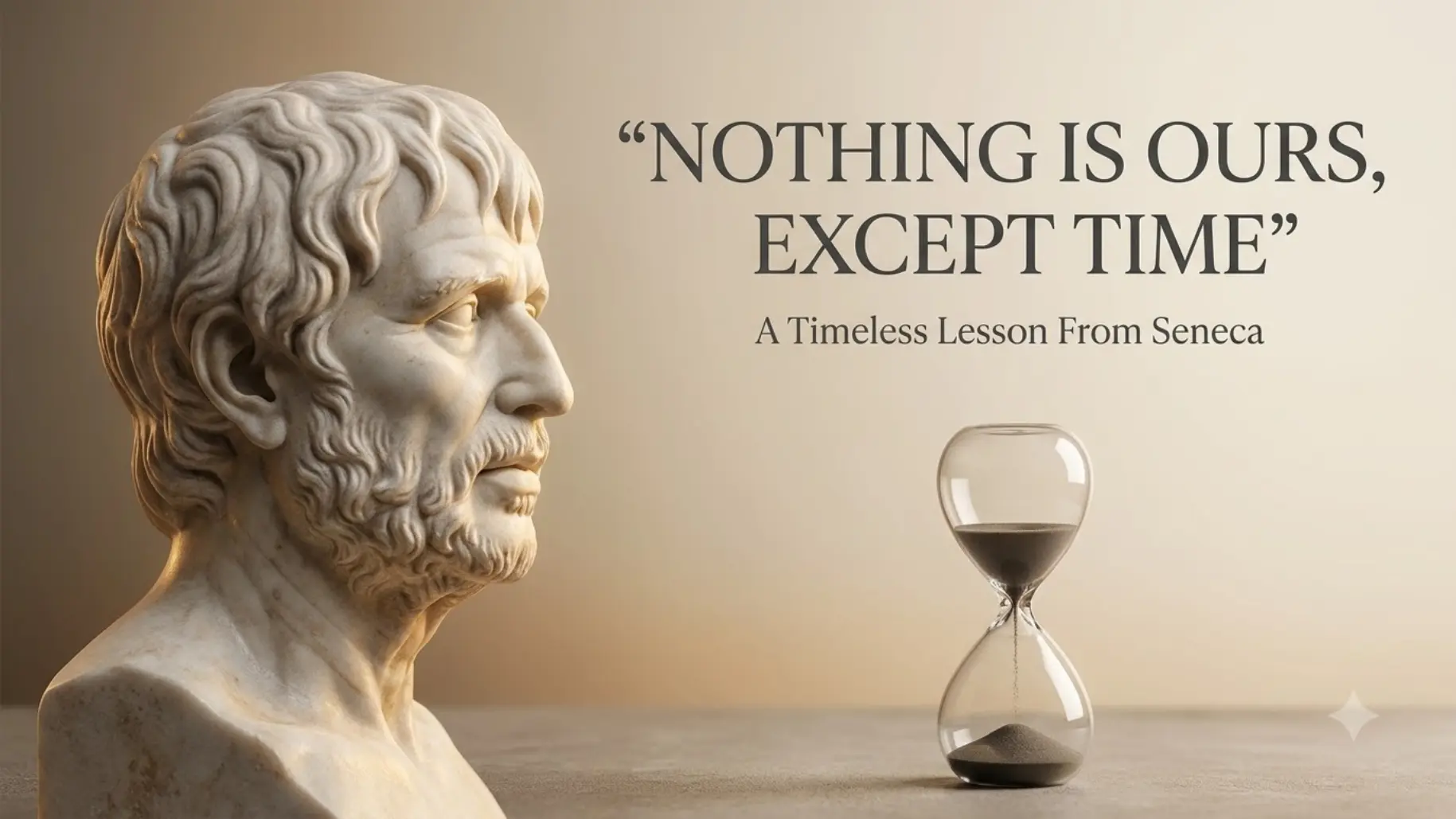
Thought of the day: “Nothing, Lucilius, is ours, except time.”
“Nothing, Lucilius, is ours, except time. We were entrusted by nature with the ownership of this single thing, so fleeting and slippery that anyone who will can oust us from possession.”

This powerful observation from the ancient Roman Stoic philosopher Seneca reminds us that almost everything we possess is temporary. Wealth can disappear, property can change hands, professional status can decline, and material belongings can be damaged or taken away. Time, however, is the one resource that belongs to us in a deeply personal sense.
Seneca’s message is not merely about managing a schedule. It is about recognizing that life itself is measured in time. Every hour spent carelessly is a portion of life that cannot be recovered.
Table of Contents
What Seneca’s Quote Means
Seneca addressed these words to Lucilius, the recipient of his famous moral letters. The thought appears in the opening letter, traditionally titled “On Saving Time.” In it, Seneca urges Lucilius to take control of the hours that are lost through distraction, neglect, and unnecessary obligations.

The central meaning of the quote is simple: we often protect money and property more carefully than we protect our time.
People may become upset when someone wastes their money, yet they frequently allow conversations, habits, digital distractions, and meaningless commitments to consume entire days. Seneca considered this carelessness especially serious because money may be earned again, while lost time is gone permanently.
His words encourage us to ask a difficult but necessary question: Are we consciously using our time, or are we allowing other people and circumstances to decide how our lives are spent?
Why Time Is Our Most Valuable Possession
Most possessions exist outside us. A house may legally belong to someone, but it can be sold, inherited or destroyed. A job title may provide authority, but it can disappear after retirement or organizational change.
Time is different. The hours available to each individual form the substance of that person’s life. To lose an hour is not merely to lose a place on a calendar. It is to lose an hour of experience, opportunity, and existence.
This is why Seneca describes time as both precious and fragile. It passes silently, often without creating an obvious sense of loss. A person may notice missing money immediately, but may not notice months disappearing through procrastination, routine, or constant distraction.
Modern life makes the warning even more relevant. Notifications, social media feeds, endless entertainment, and workplace interruptions compete continuously for attention. Although these activities may appear harmless individually, their cumulative effect can consume a significant part of a person’s day.
The Difference Between Being Busy and Living Well
Seneca’s thought also challenges the belief that constant activity is evidence of a meaningful life.
A person may remain busy from morning until night and still make little progress towards anything important. Meetings, messages, errands, and obligations can create the appearance of productivity while leaving no time for reflection, relationships, learning, or personal growth.
Stoic philosophy does not suggest abandoning responsibilities. Instead, it asks people to distinguish between necessary action and unnecessary occupation.
Being busy means that time is filled. Living deliberately means that time is directed.
This distinction matters because a crowded schedule can become a convenient way to avoid examining one’s priorities. Seneca’s words encourage us to stop treating every demand as equally important and to reserve time for activities that reflect our values.
How Time Slips Away
Time is not always lost through dramatic mistakes. It is more commonly lost in small, repeated ways.
A few minutes of unnecessary scrolling may become an hour. A task repeatedly postponed may occupy mental space for several days. An unwanted commitment accepted out of discomfort may consume an entire weekend. Constant concern about events beyond our control may exhaust the present without improving the future.
Seneca observed that some moments are taken from us, some are quietly removed, and others simply slip away. His argument was that the most troubling loss occurs through carelessness.
This does not mean every moment must be productive. Rest, recreation, and unstructured thought are valuable when chosen consciously. The problem begins when time is spent automatically, without awareness or intention.
A Stoic Approach to Using Time
The Stoic response is not to become anxious about every passing minute. Anxiety itself can waste the present. The better approach is to become more deliberate.
Begin by identifying what genuinely deserves your time. Important work, physical health, close relationships, learning, and inner development usually provide greater long-term value than activities driven by comparison, habit, or social pressure.
It is also useful to place limits on activities that expand indefinitely. Emails, news consumption, meetings, and social media can occupy all available space unless clear boundaries are established.
Seneca’s advice can be applied through one practical principle: Give your best hours to your most important priorities.
Do not reserve meaningful work for whatever time remains after distractions. Protect it first. Treat attention as a limited resource and recognize that every unnecessary “yes” is also a “no” to something else.
Questions to Ask Yourself Today
Seneca’s thought becomes useful when it leads to honest reflection.
Ask yourself:
- Which activity is consuming more time than it deserves?
- What important task have I repeatedly postponed?
- Which commitments are based mainly on guilt or social pressure?
- How much of my day is spent reacting rather than choosing?
- What would I do today if I treated time as my most valuable possession?
The answers may reveal that the problem is not a lack of time but a lack of clarity. Most people cannot control every demand placed upon them, but they can usually exercise greater control over their attention, boundaries, and priorities.
The Deeper Lesson Behind Seneca’s Words
Seneca was an ancient Roman philosopher, statesman, and writer whose letters explored ethics, discipline, mortality, and the pursuit of a meaningful life. His writings remain central to the study of Roman Stoicism because they translate philosophical principles into practical advice for daily living.
The deeper lesson behind this quotation is that awareness of time should improve life rather than create fear.
Remembering that time is limited can help us speak honestly, forgive sooner, begin important work, and stop postponing meaningful experiences. It can also help us recognize that protecting time is not selfish when it allows us to live with greater purpose and integrity.
Seneca’s message is therefore both a warning and an invitation. The warning is that life can disappear through neglect. The invitation is to reclaim the present before it becomes the past.
Learnings from this “Thought”
“Nothing, Lucilius, is ours, except time” asks us to reconsider what true ownership means.
We may spend years accumulating possessions while casually surrendering the hours required to enjoy them. We may worry about losing money while giving away entire days to distraction, resentment or unnecessary pressure.
Time cannot be stored for later. It cannot be replaced, borrowed, or recovered. It can only be used while it is available.
The most appropriate response to Seneca’s thought is not to rush through life, but to become more selective about how we live it. Guard your hours carefully, direct your attention intentionally, and remember that how you spend your time is ultimately how you spend your life.