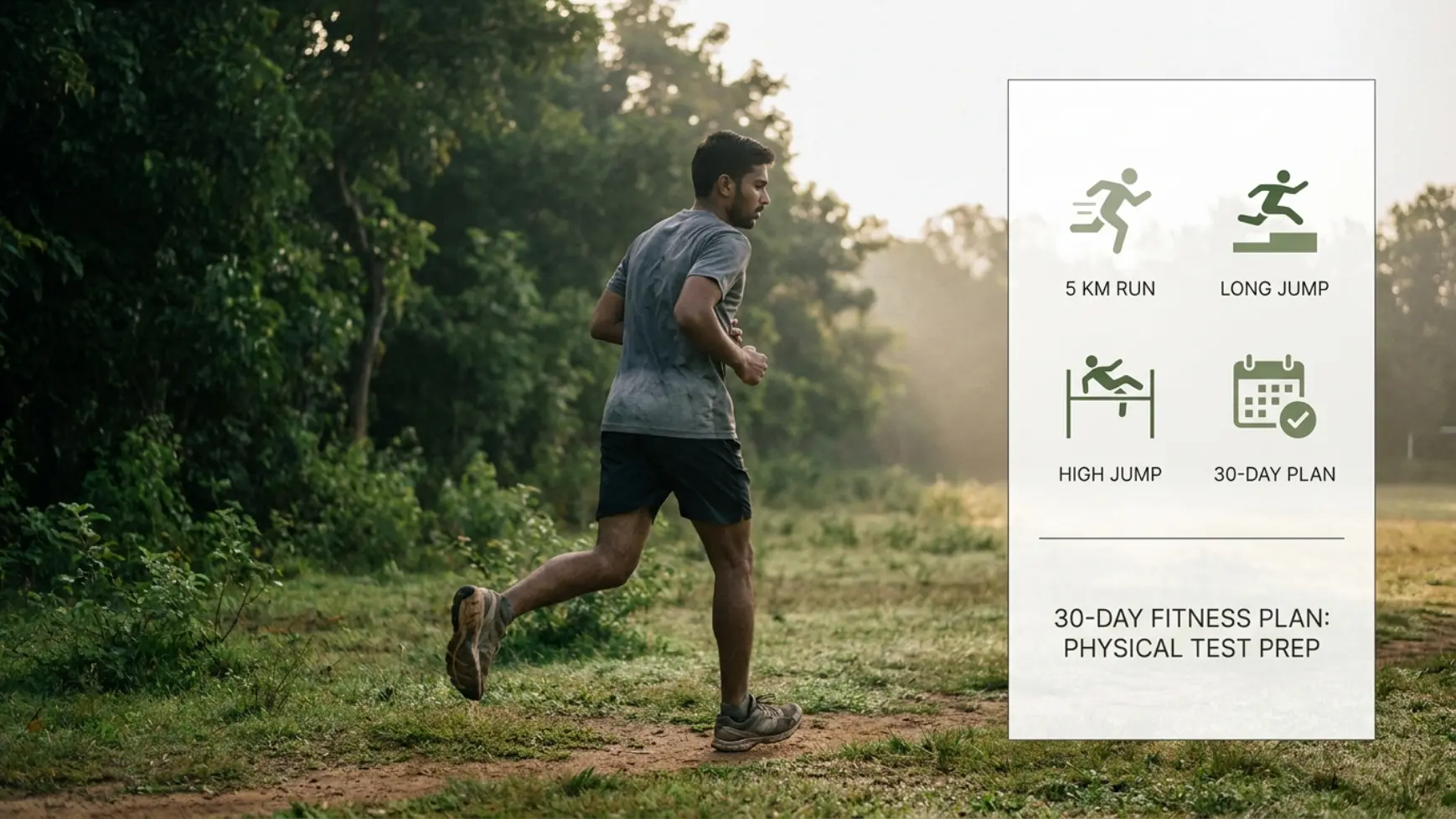
The Karnataka Forest Department’s physical efficiency test eliminates more candidates than any written exam component. Among 8,000 applicants who appeared for the 2023 Forest Guard recruitment in Karnataka, physical test failures accounted for nearly 40 percent of total rejections. A structured 30-day fitness plan addresses the specific demands of this assessment while building the endurance, strength, and agility forest guard duties require.
Table of Contents
Understanding Karnataka Forest Guard Physical Requirements
The physical test evaluates running speed, endurance, and basic strength through standardized exercises. Male candidates must complete a 5-kilometer run within 25 minutes, while female candidates must finish the same distance in 30 minutes. Additional components include long jump (minimum 3.5 meters for men, 2.75 meters for women) and high jump (minimum 1.2 meters for men, 0.9 meters for women).

Karnataka’s forest terrain introduces unique challenges beyond flat-ground testing. The Western Ghats forests require navigating steep inclines, while coastal forest regions demand heat tolerance. Candidates preparing in Bangalore or Mysuru must account for altitude differences when training for positions in hill stations like Chikmagalur or Kodagu districts. According to Karnataka Forest Department official portal, these benchmarks reflect actual field conditions officers encounter during anti-poaching patrols and wildlife monitoring duties.
| Exercise Component | Male Standard | Female Standard | Primary Skills Tested |
|---|---|---|---|
| 5 km Run | 25 minutes | 30 minutes | Cardiovascular endurance, pacing |
| Long Jump | 3.5 meters | 2.75 meters | Explosive leg power, coordination |
| High Jump | 1.2 meters | 0.9 meters | Vertical power, technique |
Week One: Baseline Assessment and Foundation Building
Begin with an honest evaluation of current fitness levels. On day one, time your 5-kilometer run without pushing to exhaustion. Record long jump and high jump attempts using proper technique. This baseline data shapes the remaining 29 days and prevents overtraining injuries that derail preparation.
Days two through seven focus on building aerobic base and movement patterns. Run 3 kilometers daily at a comfortable pace where conversation remains possible. Alternate days with bodyweight strength circuits: 20 squats, 15 push-ups, 20 lunges per leg, 30-second plank hold, repeated three times. Practice jump techniques on softer surfaces like grass or sand to reduce joint impact while learning proper form.

Morning sessions between 6 AM and 8 AM prepare the body for Karnataka’s forest patrol schedules, which typically begin at dawn. Training in Cubbon Park in Bangalore or Chamundi Hills in Mysuru simulates the natural terrain conditions better than indoor facilities.
Week Two: Progressive Overload and Speed Introduction
Increase running volume to 4 kilometers, maintaining the same comfortable pace from week one. Introduce one interval session mid-week: alternate between two minutes of faster running and two minutes of recovery jogging for 20 total minutes. This pattern builds the speed reserves needed to finish within time limits while managing fatigue.
Strength training progresses to weighted exercises if equipment is available. Add a 5-kilogram backpack during squats and lunges to simulate carrying forest equipment. Jump practice moves to technical refinement, focusing on arm swing coordination for long jump and approach rhythm for high jump. Film your attempts with a phone camera to identify form breakdowns.
Week Three: Specificity and Test Simulation

Running volume reaches 5 kilometers by day 15, completed at least four times during the week. One session should target race pace, breaking the distance into 1-kilometer segments with 90-second rest between each. Track split times to identify where pace drops occur. Most candidates slow significantly after 3 kilometers due to inadequate aerobic conditioning.
Dedicate two sessions to jump-specific training with full rest between attempts. Quality repetitions matter more than volume. Six to eight maximum-effort long jumps and five to six high jump attempts per session develop the neuromuscular coordination these explosive movements demand. Rest 48 hours between jump-focused workouts to allow complete recovery.
Schedule a full practice test on day 21 under actual conditions. Complete the 5-kilometer run, then rest 15 minutes before attempting jumps. This simulation reveals whether current fitness meets Karnataka Forest Department standards or requires adjustment in the final week. According to Effects of tapering on athletic performance, this timing allows adequate recovery before the actual test while providing actionable feedback.
Week Four: Taper, Refinement, and Mental Preparation
Reduce training volume by 30 percent to allow accumulated fatigue to dissipate while maintaining fitness gains. Run 3 to 4 kilometers three times this week at comfortable pace. Include one short interval session of 400-meter repeats at race pace to keep speed sharp without inducing fatigue.
Jump practice decreases to technique review only. Walk through approaches, visualize successful attempts, and perform two to three submaximal jumps focusing on form rather than distance or height. Excessive jumping during taper week increases injury risk without performance benefit.
Mental rehearsal becomes primary focus. Visualize the testing environment, hear the starting instructions, feel the ground surface under your feet. Karnataka’s forest guard tests typically occur at district headquarters or designated training centers where surfaces vary from rubberized tracks to packed earth. Prepare mentally for less-than-ideal conditions rather than expecting perfect facilities.
Nutrition, Recovery, and Test Day Strategy
Adequate sleep drives adaptation more than any single workout. Target seven to eight hours nightly, with an extra hour during week four when recovery takes priority. Karnataka’s climate requires increased hydration, particularly for candidates training through summer months when temperatures exceed 35 degrees Celsius in most regions.
Nutritional needs increase with training volume. Add one palm-sized portion of protein to each meal and increase complex carbohydrates from rice, ragi, or whole wheat by approximately 20 percent. Avoid introducing new foods during the final week to prevent digestive disruption on test day.
On test morning, eat a familiar breakfast three hours before reporting time. Rice with sambar or idli with chutney provide sustained energy without digestive stress. Arrive 45 minutes early to complete a thorough warm-up: light jogging, dynamic stretching, and practice starts. The 30-day plan delivers results when execution on test day matches preparation quality during the preceding month.