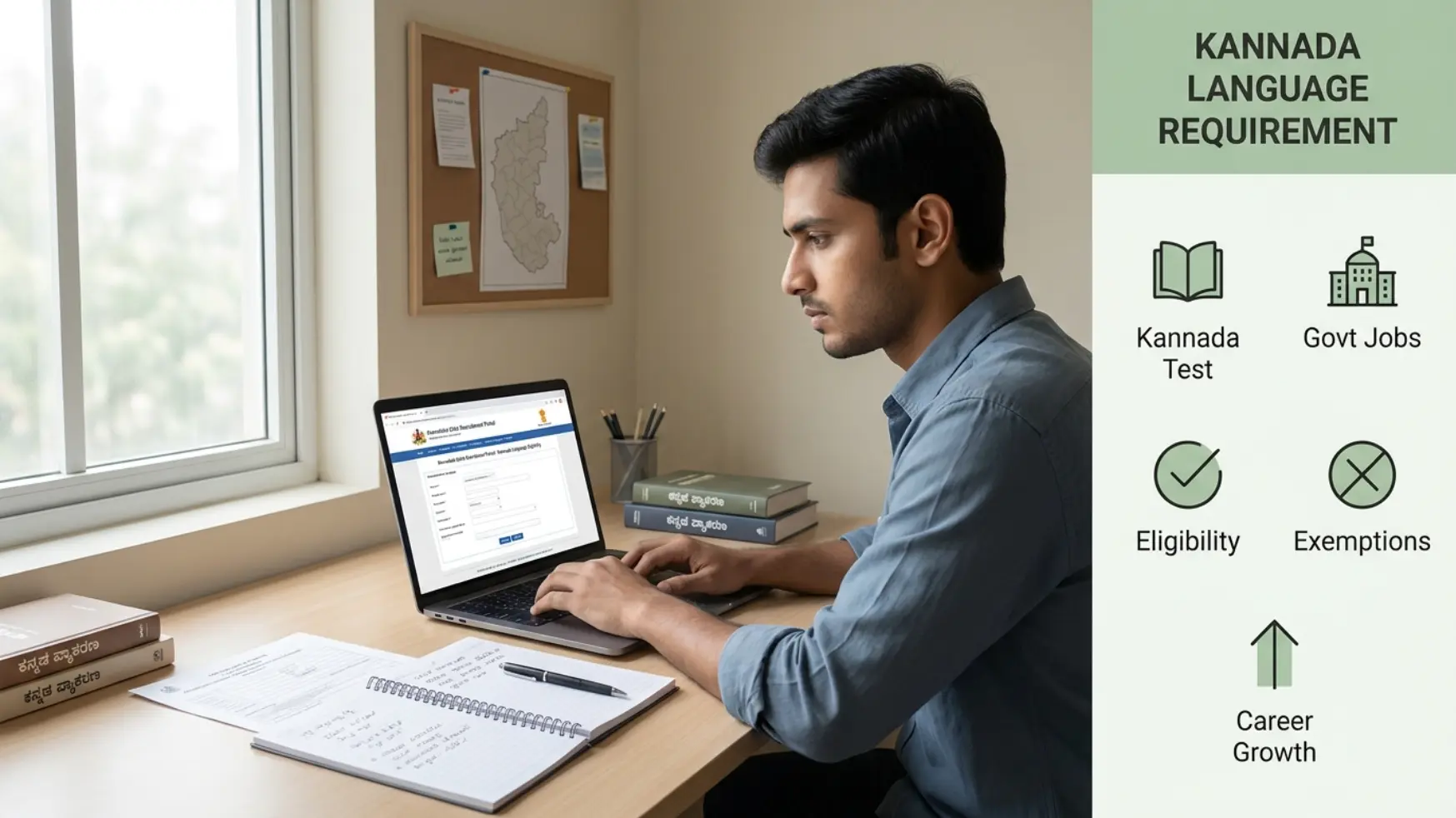
Karnataka’s government recruitment process requires proficiency in Kannada for most positions, a policy designed to preserve regional linguistic identity while ensuring administrative efficiency. The requirement affects thousands of job seekers annually across Karnataka, from Bengaluru’s urban job market to rural district offices in Mysuru, Mangaluru, and Hubballi.
Table of Contents
Legal Framework Governing Language Requirements
The Karnataka Official Language Act, 1963 established Kannada as the state’s official language for administrative purposes. This legislation mandates that candidates seeking government positions demonstrate working knowledge of Kannada, though implementation varies by position level and department. Group A and Group B positions typically require reading, writing, and speaking proficiency, while Group C and Group D roles may have modified requirements based on job functions.

The Karnataka Public Service Commission (KPSC) enforces these standards through written examinations and language proficiency tests. Candidates must pass a Kannada language paper as part of the selection process for most civil service positions. According to [CITE: Karnataka Public Service Commission language test requirements official guidelines], the examination assesses comprehension, translation abilities, and administrative vocabulary relevant to government work.
Exemptions and Special Provisions
Certain categories of applicants receive exemptions from strict Kannada requirements. Technical positions in engineering, medicine, and specialized scientific roles often waive the language prerequisite during initial recruitment, though employees must demonstrate proficiency within a specified probation period, usually two to three years. Non-residents of Karnataka recruited for specialized expertise receive extended learning windows.
The state government recognizes certificates from approved Kannada learning institutions as valid proof of competency. The Karnataka Sahitya Parishat and several universities across Bengaluru, Mysuru, and Dharwad offer certification programs ranging from basic proficiency to advanced administrative Kannada. These courses typically span six months to one year, covering grammar, composition, and official correspondence formats.
| Position Category | Kannada Requirement Level | Exemption Availability | Compliance Timeline |
|---|---|---|---|
| Group A (Gazetted Officers) | High proficiency required | Rare, case-by-case | Must pass before confirmation |
| Group B (Non-Gazetted Officers) | Moderate to high proficiency | Technical roles only | Within three years of joining |
| Group C (Clerical/Assistants) | Working knowledge mandatory | Limited for specialized posts | Mandatory at recruitment |
| Group D (Support Staff) | Basic communication skills | Rare | Mandatory at recruitment |
Impact on Non-Kannada Speaking Applicants

The language requirement presents challenges for migrants and non-native speakers seeking government employment in Karnataka. States like Tamil Nadu, Kerala, and Maharashtra supply significant portions of Karnataka’s workforce, particularly in Bengaluru’s technology and industrial sectors. These candidates must invest time and resources in language acquisition to qualify for government positions.
Private coaching centers across Bengaluru, Mysuru, and Hubballi report increased enrollment in Kannada proficiency courses among job aspirants. According to [CITE: Karnataka employment statistics language proficiency impact], approximately 35 percent of government job applicants require supplementary Kannada training before meeting eligibility standards. This demographic includes engineering graduates, medical professionals, and business administration degree holders from other states.
Critics argue the policy limits the talent pool for specialized positions requiring rare expertise. Supporters counter that government employees must communicate effectively with Karnataka’s rural population, where Kannada remains the primary language. Forest department positions in Western Ghats regions, agricultural extension officers in northern districts, and health workers in coastal areas all require direct vernacular communication with local communities.
Enforcement Mechanisms and Compliance Monitoring

The Department of Personnel and Administrative Reforms (DPAR) monitors compliance across state departments. New recruits who received exemptions must submit progress reports on their Kannada learning every six months. Failure to achieve required proficiency within the stipulated period can result in service termination or transfer to non-public-facing roles.
Government offices in Bengaluru, Mysuru, Belagavi, and Kalaburagi conduct periodic assessments of employee language skills. These evaluations measure practical communication abilities rather than academic grammar knowledge. Officers working in revenue departments, police administration, and municipal corporations face stricter scrutiny given their daily interaction with citizens.
Practical Implications for Career Advancement
Kannada proficiency affects promotion prospects within Karnataka’s civil services. Senior positions require demonstrated ability to draft official communications, understand legal documents, and conduct meetings in Kannada. Officers seeking transfers to district collector roles, superintendent positions, or departmental secretary appointments must exhibit advanced language competency.
The policy creates a dual track within government employment. Local Kannada-speaking candidates often advance faster through administrative hierarchies, while technically skilled non-native speakers concentrate in specialized departments with reduced public interaction. This division influences long-term career trajectories and departmental leadership composition across Karnataka’s bureaucracy.
Job seekers targeting Karnataka government positions should begin Kannada learning well before application deadlines. Universities, online platforms, and community education centers offer resources tailored to administrative vocabulary and official correspondence styles. Early preparation expands eligibility across departments and improves competitive positioning in Karnataka’s evolving public sector employment landscape.