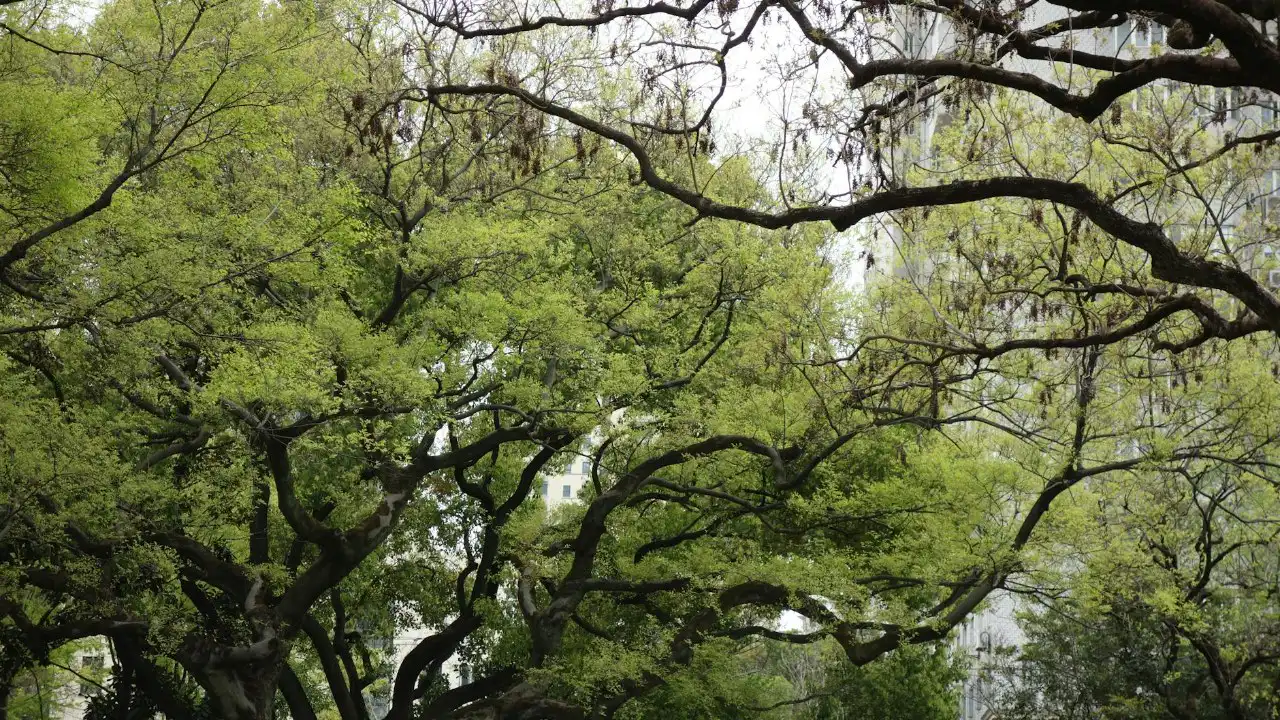
Karnataka faces mounting air quality challenges across its urban centers, from Bengaluru’s traffic emissions to industrial pollution in Hubballi-Dharwad. Trees offer a scientifically proven solution to these environmental pressures while simultaneously addressing the state’s rising temperature patterns. Urban forests and strategic tree placement can reduce ambient temperatures by 2 to 8 degrees Celsius and filter harmful particulates from the atmosphere.
Table of Contents
The Science of Air Purification Through Trees
Trees function as natural air filters through a process called dry deposition. Leaves capture particulate matter — including PM2.5 and PM10 pollutants that plague cities like Bengaluru and Mysuru — on their surface area. A single mature tree can absorb up to 48 pounds of carbon dioxide annually while releasing oxygen sufficient for two people. Stomata, the microscopic pores on leaves, pull in polluted air and trap contaminants while processing carbon dioxide through photosynthesis.
Different species demonstrate varying filtration capacities. According to [CITE: trees air pollution removal capacity Karnataka species], native species like neem, peepal, and banyan trees show exceptional pollutant absorption rates in tropical climates. The rough-textured bark and dense canopy structure of these species create greater surface area for particle capture. Research from the Indian Institute of Science demonstrates that tree-lined streets in Bengaluru’s residential areas show 24 percent lower particulate concentrations compared to roads without tree cover.
Urban Heat Island Mitigation Across Karnataka Cities
Concrete and asphalt surfaces in expanding cities absorb and retain solar radiation, creating urban heat islands where temperatures spike 3 to 7 degrees higher than surrounding rural areas. Bengaluru experienced this phenomenon acutely as its green cover declined from 68 percent in the 1960s to approximately 16 percent today. Trees counter this effect through evapotranspiration, releasing water vapor that cools surrounding air.
Strategic tree placement produces measurable cooling benefits. Shade trees positioned on the west and southwest sides of buildings can reduce air conditioning costs by 15 to 35 percent. Parks with mature tree canopies, such as Cubbon Park in Bengaluru or the Brindavan Gardens near Mysuru, register temperatures 5 to 7 degrees lower than adjacent commercial districts during peak summer months.
| Tree Species | Annual CO2 Absorption (kg) | Cooling Potential | Air Quality Improvement |
|---|---|---|---|
| Neem (Azadirachta indica) | 20-25 | High | Excellent PM capture |
| Peepal (Ficus religiosa) | 24-28 | Very High | 24-hour oxygen release |
| Banyan (Ficus benghalensis) | 22-26 | Very High | Large canopy filtration |
| Gulmohar (Delonix regia) | 18-22 | Moderate | Shade-focused cooling |
| Indian Beech (Pongamia pinnata) | 15-20 | Moderate | Drought-resistant filter |
Quantifiable Health Benefits for Karnataka Residents

Poor air quality contributes to respiratory diseases, cardiovascular conditions, and premature mortality across Karnataka’s population centers. The state’s industrial corridors and vehicle density create pollution levels that regularly exceed safe limits established by national air quality standards. Trees address this crisis by removing nitrogen dioxide, sulfur dioxide, and ozone alongside particulate matter.
A comprehensive urban forestry program delivers direct health outcomes. Studies show that neighborhoods with 30 percent tree canopy coverage report 15 to 20 percent fewer respiratory emergency visits compared to areas with minimal greenery. Children attending schools surrounded by trees demonstrate improved cognitive function and reduced asthma incidence. For Karnataka’s rapidly growing cities, these health dividends translate to reduced healthcare costs and improved quality of life.
Implementation Strategies for Maximum Impact
Effective tree planting requires species selection matched to local soil conditions, water availability, and intended function. Native species adapt better to Karnataka’s climate variations, from coastal humidity in Mangaluru to semi-arid conditions in northern districts. Fast-growing species provide quicker cooling benefits, while slower-growing hardwoods offer long-term carbon sequestration.
Urban planners should prioritize tree corridors along major transportation routes where pollution concentrations peak. Residential neighborhoods benefit from mixed-species planting that provides year-round canopy coverage. According to [CITE: Karnataka forest department urban greening guidelines 2023], the state aims to increase urban tree cover by 12 percent over five years through coordinated municipal initiatives.
Community participation amplifies these efforts. Resident welfare associations can organize neighborhood planting drives, while schools and colleges can establish campus forests. Maintenance proves equally critical — young trees require consistent watering and protection during establishment phases. Karnataka’s monsoon patterns provide natural irrigation, but supplemental watering during dry months ensures survival rates above 80 percent.
Economic and Environmental Returns on Investment
Tree planting represents one of the most cost-effective environmental interventions available. A single tree planted today yields benefits worth thousands of rupees over its lifetime through air purification, temperature regulation, and stormwater management. Property values increase 7 to 15 percent in tree-lined neighborhoods, while businesses report higher customer traffic in shaded commercial districts.
Beyond individual benefits, widespread tree coverage addresses climate adaptation needs. Karnataka’s agricultural regions face increasing temperature stress and irregular rainfall patterns. Agroforestry systems that integrate trees with crops improve soil moisture retention, reduce erosion, and create microclimates that buffer against extreme weather. Forest cover restoration in the Western Ghats protects watersheds that supply water to millions of residents across the state.
For Karnataka to meet its environmental and public health goals, tree planting must transition from periodic campaigns to systematic policy. Every new construction project, road expansion, and urban development plan should mandate compensatory tree planting that exceeds removal numbers. Citizens, activists, and government bodies share responsibility for transforming Karnataka’s landscape into a cooler, cleaner, healthier environment where trees form the foundation of sustainable growth.