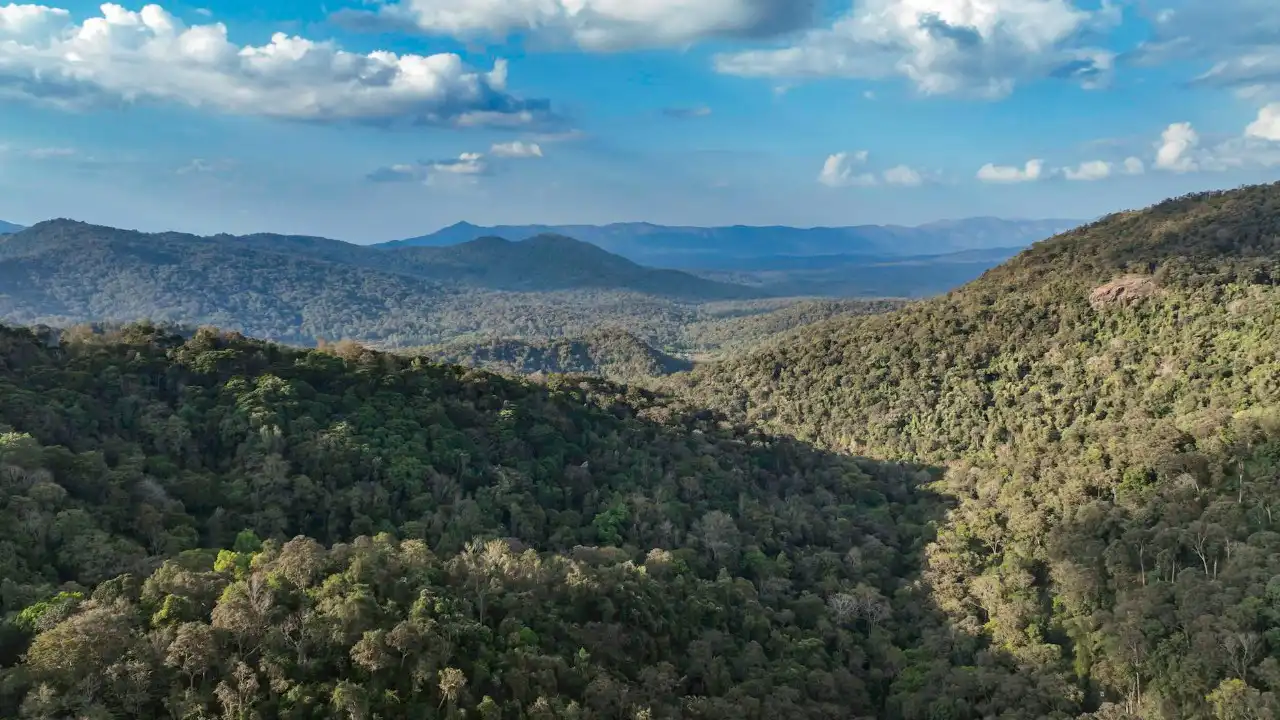
Karnataka has witnessed a troubling reduction in its forest cover over recent decades, triggering cascading effects that reach far beyond the boundaries of protected reserves. When forest cover declines in a region like Karnataka, where the Western Ghats form one of the world’s biodiversity hotspots, the consequences ripple through ecosystems, economies, and daily life. Understanding these impacts is essential for residents, policymakers, and anyone concerned with the state’s environmental future.
Table of Contents
Disrupted Water Security and Monsoon Patterns
Forests act as natural water towers, capturing rainfall and releasing it gradually into rivers and groundwater systems. Karnataka’s major rivers—the Cauvery, Krishna, and Tungabhadra—depend heavily on forested catchment areas in the Western Ghats. As tree cover diminishes, soil loses its capacity to absorb and retain moisture. Rain runs off quickly rather than percolating into aquifers, leading to seasonal water scarcity even in traditionally water-rich districts.

The relationship between forest cover and regional climate operates as a feedback loop. Trees release moisture through transpiration, contributing to local cloud formation and precipitation patterns. When forest cover declines in areas like Kodagu or Chikmagalur, the microclimate shifts. According to Western Ghats monsoon rainfall study, reduced tree density correlates with altered monsoon behavior, including delayed onset and erratic distribution of rainfall. Farmers across the Malnad region have reported increasingly unpredictable growing seasons, directly linked to diminished forest buffers.
Biodiversity Loss and Ecosystem Collapse
Karnataka hosts numerous endemic species found nowhere else on Earth. The state’s forests provide habitat for tigers, elephants, gaur, and countless bird and insect species. When forest cover declines, habitat fragmentation isolates animal populations, preventing genetic exchange and reducing long-term survival prospects. Elephant-human conflict has intensified in Hassan, Mysuru, and Chamarajanagar districts as shrinking forests force wildlife into agricultural areas searching for food and passage.
The disappearance of primary forests eliminates specialized niches that support rare species. The Lion-tailed Macaque, endemic to the Western Ghats, requires continuous canopy cover to survive. Similarly, the Malabar Giant Squirrel depends on mature trees for nesting and feeding. Once these keystone species vanish, entire ecological networks unravel. Pollinator populations decline, affecting both wild plant reproduction and agricultural productivity in surrounding areas.
Economic Consequences for Rural Livelihoods

Millions of Karnataka residents depend on forests for non-timber forest products (NTFPs) including honey, tamarind, soap nuts, and medicinal plants. When forest cover declines, these income sources evaporate. Tribal communities in Chamarajanagar and Raichur districts, who have harvested forest products sustainably for generations, face economic displacement as their traditional knowledge becomes irrelevant without intact ecosystems.
The tourism economy also suffers measurable losses. Karnataka’s forest reserves attract visitors to destinations like Bandipur, Nagarhole, and Dandeli. Degraded forests offer diminished wildlife viewing experiences, reducing tourist arrivals and the associated revenue for local guides, hospitality workers, and transportation providers. The state’s coffee and spice plantations, often situated in forest-adjacent areas, experience productivity declines as natural pest control and pollination services weaken.
| Impact Category | Short-Term Effect (1-5 years) | Long-Term Effect (10+ years) |
|---|---|---|
| Water Availability | Reduced stream flow during dry months | Aquifer depletion, permanent spring loss |
| Soil Quality | Increased erosion, nutrient runoff | Topsoil loss, reduced agricultural productivity |
| Wildlife Populations | Habitat fragmentation, increased conflict | Local extinctions, ecosystem simplification |
| Climate Regulation | Temperature extremes, altered rainfall | Desertification risk in vulnerable zones |
| Rural Economy | Reduced NTFP yields, crop failures | Out-migration, loss of traditional livelihoods |
Soil Degradation and Agricultural Vulnerability
Healthy forests prevent soil erosion by anchoring topsoil with root networks and cushioning rainfall impact with canopy cover. When forest cover declines, exposed soil washes away during monsoons, silting rivers and reservoirs while depleting agricultural land. The Krishna Raja Sagara dam and Tungabhadra reservoir have experienced accelerated sedimentation rates as upstream forests disappear, reducing water storage capacity and irrigation potential.
Farmers in deforested areas face a dual crisis: declining soil fertility and increased pest pressure. Forest ecosystems support natural predators that control agricultural pests. Without these biological controls, farmers resort to heavier pesticide use, creating cost burdens and health risks. The transition from forest to agriculture often proves economically unsustainable within one or two generations as yields decline and input costs escalate.
Climate Change Amplification
Forests sequester massive quantities of carbon dioxide, functioning as critical climate regulators. Karnataka’s forests store an estimated millions of tons of carbon in biomass and soil. When forest cover declines, this stored carbon releases into the atmosphere, accelerating global warming while simultaneously removing a natural carbon sink. According to carbon sequestration potential study, each hectare of mature forest lost represents decades of carbon accumulation returned to atmospheric circulation.
The loss creates a compound effect: reduced forest cover means less capacity to absorb future emissions while past sequestered carbon now contributes to the problem. Urban areas like Bengaluru already experience elevated temperatures partly attributable to diminished green cover in surrounding districts. Rising temperatures stress remaining forest patches, creating conditions for increased fire risk and further degradation.
Pathways Toward Forest Recovery
Reversing forest decline requires coordinated action across government agencies, local communities, and private stakeholders. Karnataka’s compensatory afforestation programs show promise when implemented with ecological rigor rather than numerical targets alone. Native species plantations that restore ecosystem function prove far more valuable than monoculture timber plots that meet reforestation quotas on paper while providing minimal environmental benefit.
Community forest management models, where local populations gain stewardship rights and direct economic benefits from sustainable forest use, have demonstrated success in Uttara Kannada and Shimoga districts. These initiatives align conservation incentives with livelihood security, creating stakeholders invested in long-term forest health. Technology solutions including satellite monitoring and AI-based encroachment detection offer enforcement tools, but ultimately forest recovery depends on recognizing that healthy ecosystems and human prosperity are inseparable rather than competing interests.