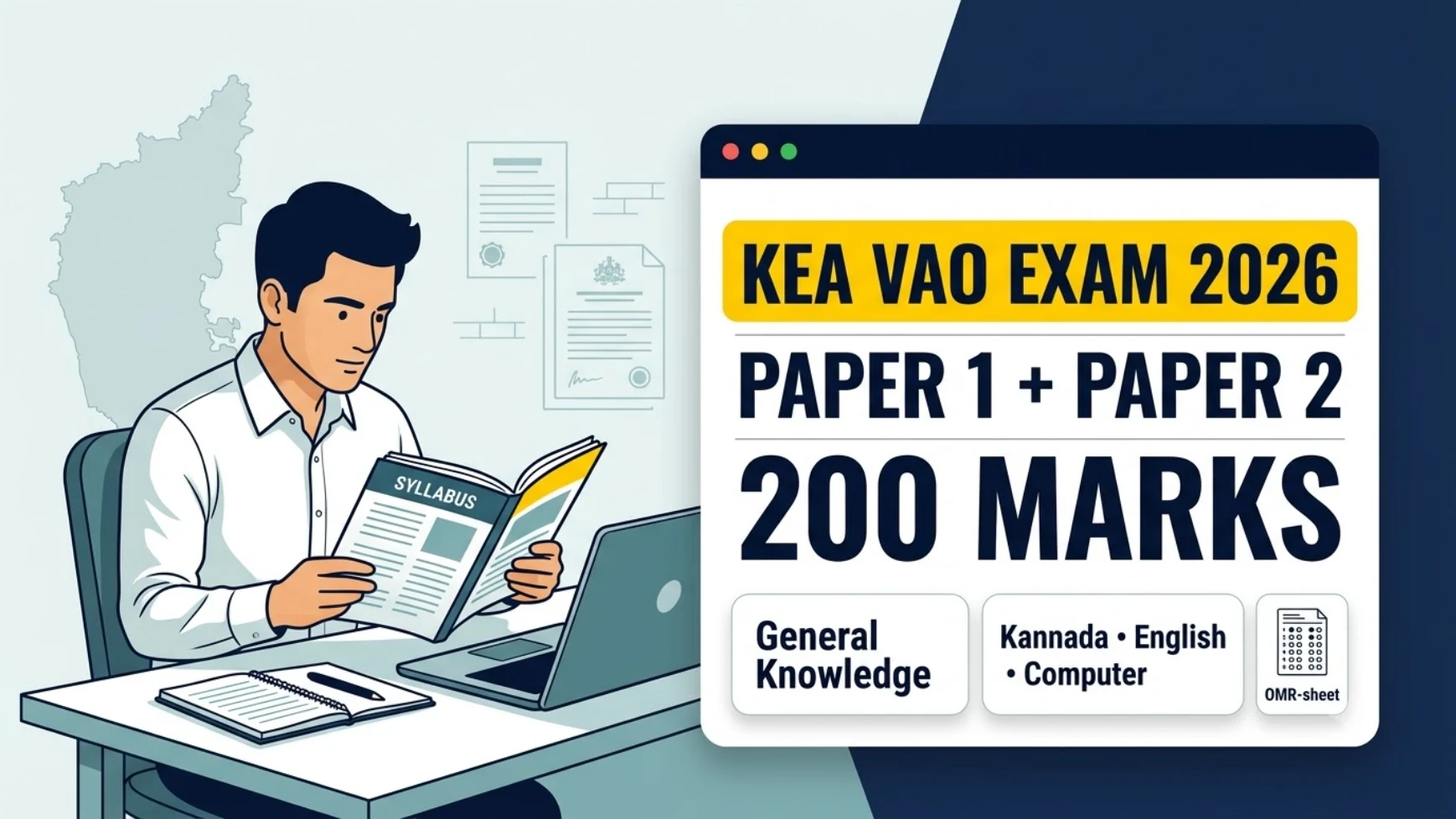
The KEA Village Administrative Officer application phase has concluded, shifting candidates’ attention to the written examination. Applicants should now understand the KEA VAO syllabus 2026, examination pattern, subject distribution, negative-marking rules and preparation priorities before beginning intensive study.
The Karnataka Examinations Authority is conducting the recruitment for 572 Village Administrative Officer posts in the Karnataka Revenue Department. These include 505 vacancies under the Residual Parent Cadre and 67 under the Kalyana-Karnataka cadre. The competitive examination will be conducted through offline OMR sheets, with two objective-type papers carrying 100 marks each.

Candidates should prepare separately for Paper 1 and Paper 2. Paper 1 primarily evaluates general knowledge and Karnataka-focused awareness, while Paper 2 covers General Kannada, General English and Computer Knowledge. Applicants who are required to take the compulsory Kannada Language Test must qualify in that test before progressing under the applicable recruitment rules.
Table of Contents
KEA VAO Exam 2026 Overview
| Particular | Details |
|---|---|
| Recruiting authority | Karnataka Examinations Authority |
| Department | Karnataka Revenue Department |
| Post | Village Administrative Officer |
| Total vacancies | 572 |
| RPC vacancies | 505 |
| Kalyana-Karnataka vacancies | 67 |
| Examination mode | Offline, OMR-based |
| Competitive examination | Paper 1 and Paper 2 |
| Marks per paper | 100 |
| Total written marks | 200 |
| Duration per paper | 2 hours |
| Negative marking | 0.25 mark for an incorrect answer |
| Interview | Not included in the reported selection process |
| Official portal | KEA recruitment portal |
KEA issued separate recruitment notifications for the RPC and Kalyana-Karnataka cadres. The written examination is expected to be followed by preparation of district-wise merit lists and document verification for shortlisted candidates.
KEA VAO Selection Process
The recruitment process is centred on candidates’ performance in the competitive written examination. Depending on their Kannada-language qualification and exemption status, some candidates may also have to appear in the compulsory Kannada Language Test.

The broad selection stages are:
- Compulsory Kannada Language Test, where applicable
- Competitive written examination
- Preparation of district-wise merit list
- Document verification
- Final appointment by the competent district authority
No separate interview stage has been reported for this recruitment. The competitive written examination is therefore the decisive stage for ranking eligible candidates.
KEA VAO Exam Pattern 2026
The competitive examination contains two papers. Both are objective-type papers conducted through OMR answer sheets.
| Paper | Subjects | Questions | Marks | Duration |
|---|---|---|---|---|
| Paper 1 | General Knowledge and Karnataka-related subjects | 100 | 100 | 2 hours |
| Paper 2 | General Kannada, General English and Computer Knowledge | 100 | 100 | 2 hours |
| Total | Both papers | 200 | 200 | 4 hours |

Each question carries one mark. A deduction of 0.25 mark applies to an incorrect answer. Candidates should therefore avoid random guessing and use an elimination-based approach when attempting uncertain questions.
The recruitment information also indicates a minimum qualifying requirement of 35 per cent in the competitive examination. Candidates must nevertheless aim considerably higher because final selection will depend on district-wise merit, reservation, vacancy availability and the performance of other applicants.
KEA VAO Paper 1 Syllabus
Paper 1 is the broader and more content-intensive part of the examination. It assesses general awareness, conceptual understanding and knowledge of Karnataka’s administration, society, geography and development.
Current Affairs
Candidates should prepare major developments from Karnataka, India and the world. Priority areas include:
- Karnataka government schemes and policy decisions
- State budget and economic developments
- National government programmes
- Important appointments
- Awards and honours
- Sports events
- Science and technology developments
- Environmental issues
- Important reports and indexes
- National and international organisations
Current affairs should not be studied as isolated facts. Candidates should connect major events with the relevant government department, objective, beneficiary group, location and implementing authority.
General Science
The science section is generally expected to remain at the secondary-school level. Important areas include:
- Basic physics
- Heat, light, electricity and motion
- Everyday chemistry
- Acids, bases and salts
- Metals and non-metals
- Human body systems
- Nutrition and diseases
- Plant and animal biology
- Environment and ecology
- Pollution and conservation
- Scientific discoveries and applications
Applicants should focus on practical science and everyday applications rather than advanced numerical problems.
Indian Constitution and Polity
This section requires familiarity with the constitutional and administrative structure of India. Important topics include:
- Preamble
- Fundamental Rights
- Directive Principles of State Policy
- Fundamental Duties
- President and Vice President
- Prime Minister and Council of Ministers
- Parliament
- Supreme Court and High Courts
- Governor and State Legislature
- Constitutional bodies
- Centre-state relations
- Emergency provisions
- Local self-government
- Constitutional amendments
Karnataka’s legislative and administrative institutions should be studied alongside general Indian polity.
Indian History
Candidates should cover ancient, medieval and modern Indian history, with greater attention to the freedom struggle and major political developments.
Important areas include:
- Indus Valley Civilisation
- Vedic period
- Mauryan and Gupta periods
- Delhi Sultanate
- Mughal Empire
- Bhakti and Sufi movements
- Arrival of European powers
- British expansion in India
- Revolt of 1857
- Social and religious reform movements
- Indian National Congress
- Gandhian movements
- Constitutional developments
- Independence and integration
Karnataka History and Culture
Karnataka-specific history can become a scoring area when studied systematically. Candidates should prepare:
- Ancient dynasties of Karnataka
- Kadambas
- Western Gangas
- Chalukyas
- Rashtrakutas
- Hoysalas
- Vijayanagara Empire
- Bahmani and Deccan Sultanates
- Wadiyars of Mysore
- Hyder Ali and Tipu Sultan
- Karnataka freedom movement
- Unification of Karnataka
- Kannada literature
- Major saints, poets and reformers
- Art, architecture and cultural traditions
Geography of India
Important Indian geography topics include:
- Physical divisions of India
- Mountains, plateaus and plains
- Rivers and drainage systems
- Climate and monsoon
- Soils
- Natural vegetation
- Agriculture
- Mineral resources
- Industries
- Population
- Transport
- Environmental challenges
Map-based preparation can help candidates retain rivers, mountain ranges, industrial regions and agricultural belts more effectively.
Karnataka Geography
Candidates should give special attention to:
- Physical divisions of Karnataka
- Major rivers and tributaries
- Dams and irrigation projects
- Climate and rainfall
- Soil types
- Crops and agricultural regions
- Forests and wildlife
- Mineral resources
- Industries
- Districts and administrative divisions
- Transport infrastructure
- Important geographical locations
Rural Development and Panchayat Raj
Since the Village Administrative Officer serves within Karnataka’s local revenue and rural administrative structure, this area has direct relevance to the post.
Important topics include:
- Three-tier Panchayat Raj system
- Gram Panchayat
- Taluk Panchayat
- Zilla Panchayat
- Functions of rural local bodies
- 73rd Constitutional Amendment
- Rural development programmes
- Rural employment schemes
- Housing schemes
- Drinking-water and sanitation programmes
- Social security schemes
- Role of local officials
- Village-level administration
Rural Cooperatives
Candidates should understand the structure and role of cooperative institutions, including:
- Meaning and principles of cooperation
- Cooperative societies
- Agricultural credit societies
- Dairy cooperatives
- Marketing cooperatives
- Rural credit structure
- Self-help groups
- Cooperative banking
- Role of NABARD
- Cooperative movement in Karnataka
Karnataka Regional Development
This segment may include economic and developmental disparities among Karnataka’s regions. Candidates should prepare:
- Regional imbalance
- Kalyana-Karnataka development
- Article 371J
- Rural infrastructure
- Irrigation and water management
- Agriculture and drought
- Industrial development
- Employment
- Education and healthcare
- State development boards
- Major Karnataka government initiatives
The reported Paper 1 framework covers current affairs, general science, the Constitution, Indian and Karnataka history and geography, Panchayat Raj, rural cooperative institutions and Karnataka’s regional development.
KEA VAO Paper 2 Syllabus
Paper 2 evaluates the language and computer competencies required for administrative work.
General Kannada
Candidates should prepare:
- Kannada grammar
- Vocabulary
- Synonyms and antonyms
- Correct usage
- Sentence correction
- Spelling
- Idioms and phrases
- Comprehension
- Fill-in-the-blanks
- Sentence arrangement
- Official and functional Kannada
- Basic translation-based questions
The difficulty level may vary, but candidates should prioritise grammar accuracy and reading comprehension.
General English
The English portion may cover:
- Parts of speech
- Tenses
- Articles
- Prepositions
- Subject-verb agreement
- Active and passive voice
- Direct and indirect speech
- Synonyms and antonyms
- One-word substitution
- Idioms and phrases
- Sentence correction
- Fill-in-the-blanks
- Reading comprehension
- Vocabulary
- Sentence arrangement
Candidates with weak grammar should begin with foundational rules before attempting timed practice sets.
Computer Knowledge
Computer Knowledge is likely to test practical awareness rather than programming expertise. Important topics include:
- Computer fundamentals
- Hardware and software
- Input and output devices
- Operating systems
- File and folder management
- Microsoft Word
- Microsoft Excel
- Microsoft PowerPoint
- Internet and browsers
- Computer networks
- Cybersecurity basics
- Digital payments
- Database fundamentals
- Common keyboard shortcuts
- E-governance and digital services
Paper 2 carries 100 questions for 100 marks and combines General Kannada, General English and Computer Knowledge.
Compulsory Kannada Language Test
Candidates who do not satisfy the prescribed Kannada-language exemption conditions may have to appear for a compulsory Kannada Language Test.
Available recruitment summaries indicate that the test is qualifying in nature and carries 150 marks, with candidates required to secure at least 50 marks. Its marks are not ordinarily added to the competitive merit score. Candidates should verify their exemption status and the final test instructions through the KEA notice applicable to their candidature.
Preparation should cover basic Kannada reading, writing, grammar, comprehension and practical language usage. Candidates should not ignore this test merely because it is qualifying; failure to meet the required standard can affect further consideration.
Negative Marking and OMR Rules
The KEA VAO examination uses an OMR-based objective format. Candidates should practise filling OMR sheets before the examination.
A deduction of 0.25 mark applies to an incorrect response. Recruitment information also reports the use of a fifth OMR option for unattempted questions. Leaving a question without marking any option may attract the prescribed penalty under the examination instructions. Candidates must read the hall-ticket instructions and official OMR guidelines carefully when issued.
A safe examination strategy is to divide questions into three categories:
- Questions that can be answered immediately
- Questions that can be solved through elimination
- Questions involving substantial uncertainty
Candidates should complete the first category before returning to uncertain questions.
Best Preparation Order
Candidates should begin with the subjects that carry broad factual coverage and require repeated revision.
A practical preparation order is:
- Karnataka history and geography
- Indian polity and Constitution
- Current affairs
- Panchayat Raj and rural development
- General science
- Indian history and geography
- General Kannada
- Computer Knowledge
- General English
- Full-length mock tests
Karnataka-specific subjects should receive consistent daily attention because questions from these areas can distinguish well-prepared candidates from those relying only on general competitive-exam material.
Suggested Daily Study Plan
Candidates studying for five to six hours daily may use the following schedule:
| Study block | Recommended activity |
|---|---|
| 90 minutes | Karnataka history, geography or regional development |
| 60 minutes | Indian polity, history or science |
| 45 minutes | Current affairs |
| 45 minutes | General Kannada |
| 30 minutes | General English |
| 30 minutes | Computer Knowledge |
| 45 minutes | Practice questions and revision |
The plan should be adjusted according to individual strengths. Candidates already comfortable with English may devote more time to Kannada, Karnataka General Knowledge or rural administration.
Previous-Year Papers and Mock Tests
Previous KEA recruitment papers can help candidates understand the style of objective questions, factual depth and time pressure. The 2024 VAO examination also followed a two-paper structure, making earlier papers useful for practice, although candidates should prepare according to the 2026 notification and current syllabus.
Mock tests should initially be attempted section-wise. Once the syllabus has been covered, candidates should complete full papers within the two-hour limit.
After every mock test, examine:
- Incorrect answers
- Unattempted questions
- Questions answered through guessing
- Topics taking excessive time
- Repeated factual errors
- OMR-marking mistakes
Mock-test analysis is more important than merely increasing the number of tests attempted.
Important Preparation Mistakes to Avoid
Candidates should not spend all their time on general knowledge while neglecting Kannada and Computer Knowledge. Paper 2 carries the same marks as Paper 1 and can significantly affect the final ranking.
Another common mistake is studying current affairs without revision. Weekly and monthly revision notes are essential because factual information is easily forgotten.
Candidates should also avoid using too many books for the same subject. One standard source, concise notes, previous papers and regular mock tests are generally more effective than repeatedly changing study material.
What Candidates Should Do Next
Candidates should first download and preserve their submitted application and fee-payment record. They should then prepare a subject checklist based on Paper 1 and Paper 2, collect relevant Karnataka-focused material and begin solving OMR-based practice papers.
The recruitment schedule reported with the notification places the RPC written examination on October 4, 2026, and the Kalyana-Karnataka examination on October 25, 2026. Candidates should verify their applicable examination date, Kannada-test requirement and hall-ticket schedule through subsequent KEA notices.
Frequently Asked Questions
How many papers are there in the KEA VAO examination?
The competitive written examination consists of two papers. Paper 1 covers General Knowledge and Karnataka-related subjects, while Paper 2 covers General Kannada, General English and Computer Knowledge.
How many marks does the KEA VAO written exam carry?
Paper 1 and Paper 2 carry 100 marks each, making the written examination worth a total of 200 marks.
Is there negative marking in the KEA VAO exam?
Yes. A deduction of 0.25 mark applies to each incorrect answer.
What is the duration of each paper?
Candidates receive two hours for Paper 1 and two hours for Paper 2.
Is the Kannada Language Test compulsory for everyone?
The test applies according to the Kannada-language qualification and exemption conditions prescribed in the recruitment rules. Candidates should verify their individual status from the official notification.
Is there an interview in KEA VAO recruitment?
No separate interview has been reported. Selection is primarily based on the competitive written examination, followed by merit preparation and document verification.
What should candidates study first?
Karnataka history, geography, current affairs, Indian polity, Panchayat Raj and rural development should receive early priority because they form a substantial part of Paper 1.