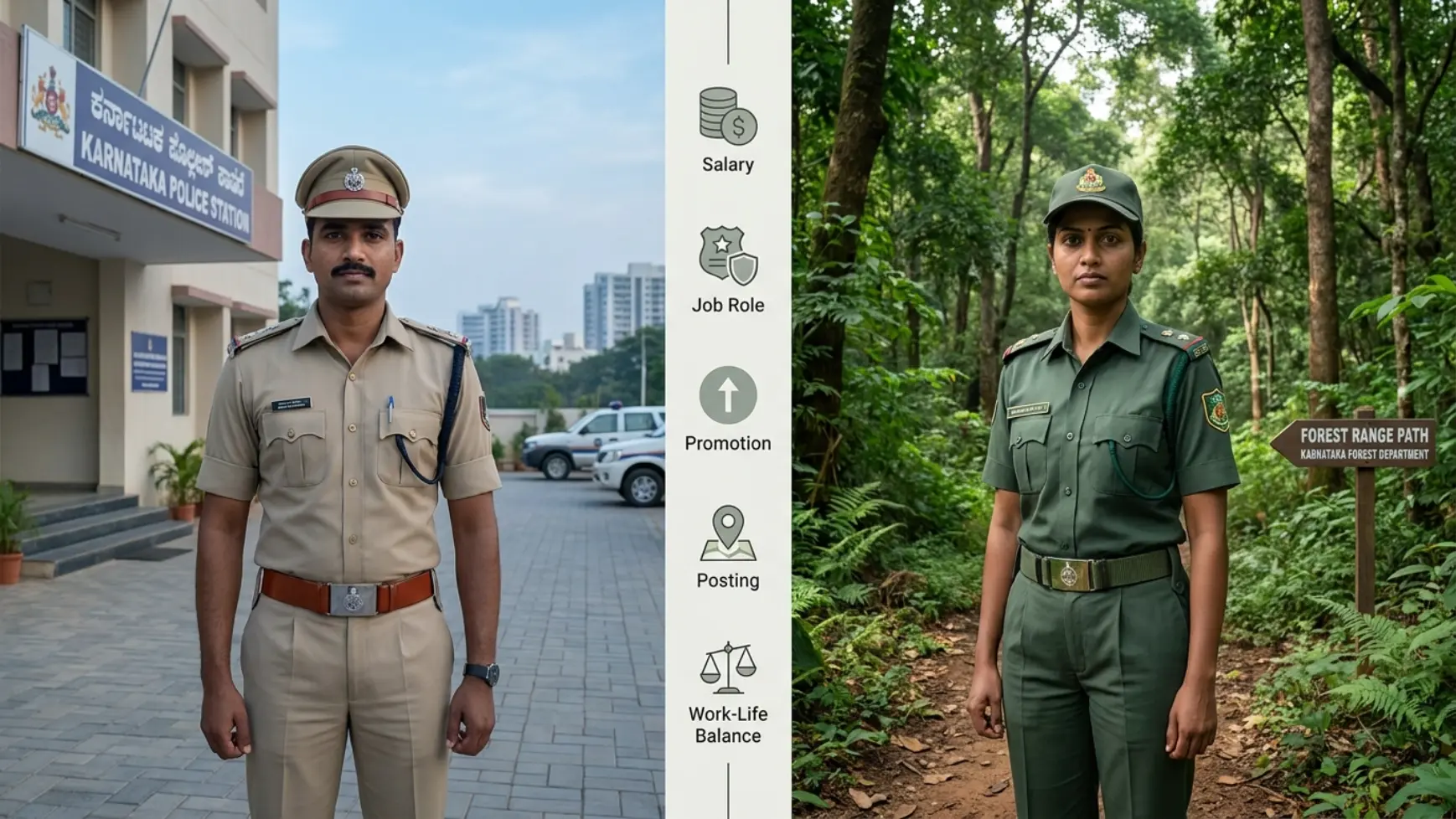
Choosing between a career in Karnataka Police and the Forest Department requires understanding fundamental differences in job roles, compensation, career progression, and lifestyle impact. Both services fall under the Karnataka state government, yet they serve distinctly different mandates — one maintains law and order across cities and rural areas, while the other protects over 38,000 square kilometers of forest cover that makes Karnataka one of India’s most ecologically diverse states.
Police constables in Karnataka start with monthly salaries between ₹21,000 and ₹25,000, while Forest Guards typically begin at ₹18,000 to ₹22,000. This gap narrows at senior levels, where Deputy Superintendents of Police and Deputy Conservators of Forests earn comparable packages in the ₹60,000 to ₹80,000 range. Both departments offer Grade Pay structures aligned with the 7th Pay Commission recommendations, though allowances differ significantly based on posting locations.
Table of Contents
Job Responsibilities and Daily Work Environment

Karnataka Police personnel handle crime investigation, traffic management, crowd control during public events, and maintaining law and order in urban centers like Bengaluru, Mysuru, and Mangaluru. The role demands physical fitness, quick decision-making under pressure, and frequent interaction with diverse communities. Officers work in shifts that include night duties, festival deployments, and emergency response situations. Postings rotate between district headquarters, rural stations, and specialized units such as the Crime Investigation Department or Traffic Police.
Forest Department staff focus on wildlife conservation, anti-poaching operations, managing protected areas like Bandipur and Nagarhole National Parks, and community outreach for ecological awareness. Forest Guards patrol designated beats covering 20 to 40 square kilometers, monitor human-wildlife conflict zones, and assist in afforestation projects. The work involves extended periods in remote forest areas, physical trekking across difficult terrain, and solitary fieldwork that contrasts sharply with the urban posting patterns common in police service. According to Karnataka Forest Department annual reports, field staff spend 15 to 20 days monthly in forest ranges during peak monitoring seasons.
Recruitment Process and Educational Requirements
Both departments conduct separate recruitment examinations managed by the Karnataka Examination Authority. Police Constable recruitment requires a Secondary School Leaving Certificate, while Forest Guard positions mandate a Pre-University Certificate or equivalent. Physical standards differ substantially — police recruitment includes running tests, high jump, and endurance assessments calibrated for law enforcement scenarios. Forest Guard selection emphasizes trekking ability and familiarity with regional geography and ecology.

The examination pattern for Karnataka Police includes General Kannada, General Knowledge, Quantitative Aptitude, and Reasoning sections, followed by physical efficiency tests and interviews. Forest Guard exams test knowledge of Karnataka geography, environmental science basics, and forest laws alongside general aptitude. Selection ratios vary annually, but forest positions generally attract fewer applicants per seat compared to police constable roles, which see competition ratios exceeding 1:50 in metropolitan regions.
Career Advancement and Long-Term Prospects
Promotional hierarchies in both services follow structured timelines, yet the pace and scope differ. Police personnel can advance from Constable to Head Constable, Assistant Sub-Inspector, Sub-Inspector, and eventually to gazetted officer ranks through departmental examinations and service tenure. Lateral entry opportunities exist for candidates with specialized skills in cybercrime or forensic science.
Forest Department careers progress from Guard to Forester, Range Forest Officer, and ultimately to Indian Forest Service positions for those who clear the UPSC Civil Services Examination. Departmental promotions typically occur slower than in police service, but the work offers greater specialization in wildlife management, ecological research, or protected area administration. Officers posted in reserves like Bandipur gain expertise recognized nationally in conservation circles.
| Career Factor | Karnataka Police | Forest Department |
|---|---|---|
| Starting Salary | ₹21,000–₹25,000 | ₹18,000–₹22,000 |
| Posting Locations | Urban and rural stations | Forest ranges and wildlife zones |
| Work Schedule | Shift-based with night duties | Extended field deployments |
| Promotion Speed | Moderate to fast | Moderate to slow |
| Job Hazards | Law and order situations | Wildlife encounters, terrain risks |
| Community Interaction | High daily contact | Periodic village outreach |
Lifestyle Considerations and Work-Life Balance

Police service offers greater proximity to urban amenities, with most personnel stationed within commutable distance of towns. Family accommodation in police quarters, access to schools, and established social infrastructure make this career suitable for those preferring connectivity. However, unpredictable duty hours, festival deployments, and emergency call-outs disrupt family routines regularly.
Forest Department postings lean toward remote areas where staff live in range offices or forest rest houses with limited connectivity. According to [CITE: Karnataka government forest staff housing policy], approximately 60 percent of field positions are in locations without reliable mobile networks or daily transportation to district centers. This isolation suits individuals drawn to nature and solitude but challenges those with family responsibilities or health concerns requiring regular medical access. The compensating factor comes in lower stress levels and the intrinsic satisfaction of conservation work that many forest staff cite as their primary motivation.
Which Service Aligns With Your Priorities
The better choice depends entirely on personal aptitudes and life goals. Police service suits candidates seeking dynamic urban careers, faster promotions, and roles with immediate societal visibility. The structured hierarchy, clear performance metrics, and diverse specialization options appeal to those who thrive in fast-paced environments with regular human interaction.
Forest Department careers attract individuals passionate about wildlife conservation, comfortable with physical fieldwork, and willing to accept slower career progression in exchange for meaningful ecological impact. The work offers deeper connection with Karnataka’s natural heritage — from the Western Ghats to the Deccan Plateau forests — and positions staff as frontline defenders of biodiversity. For environmental activists transitioning into government service, this path provides institutional support for conservation efforts.
Both services deliver job security, pension benefits, and government employee privileges. Your decision should weigh salary expectations against lifestyle preferences, urban versus rural living tolerance, and whether you find greater purpose in law enforcement or environmental stewardship. Karnataka’s future needs dedicated professionals in both spheres, making either choice a contribution to public service with distinct but equally valuable outcomes.